

Knoxville’s tech ecosystem is growing, with a need for more talent, capital, and coordination
The report is unambiguous on this point: workforce readiness, not innovation capacity, is the primary constraint on Knoxville's tech growth.
Knoxville is at a pivotal moment. That’s the headline finding of the Knoxville Technology Council (KTech) 2026 Technology State of the Union report, released this month. The thorough report provided a data-driven snapshot of where the region’s tech economy stands and what it needs to take the next step.
“My hope and desire for this report is that it will be a resource for leaders across the public and private sectors to drive informed decision making,” said Matthew Kittrell, the President of KTech and Director of Consulting Delivery for CGI.
The report draws on survey responses from 64 regional technology leaders, more than half of whom hold C-suite, VP, or director-level roles, alongside labor market and economic data. The findings span three areas: workforce and talent, the technological landscape, and the entrepreneurial ecosystem.
Here’s what Teknovation readers need to know.
The talent gap is real — and structural
The report is unambiguous on this point: workforce readiness, not innovation capacity, is the primary constraint on Knoxville’s tech growth. The issue isn’t a shortage of applicants, but rather a mismatch between the skills companies need and the talent available to fill those roles.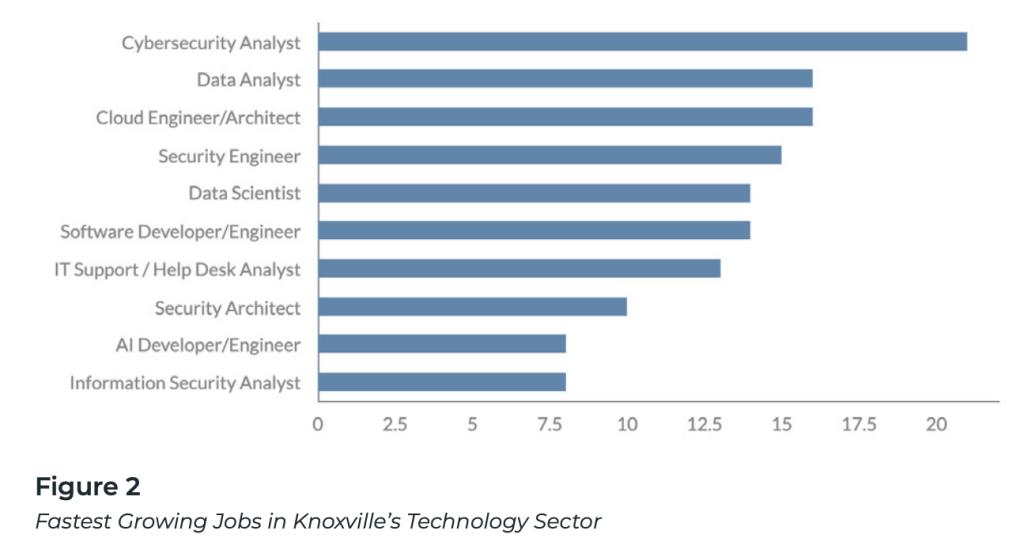
The fastest-growing roles in the region are cybersecurity analysts, data analysts, and cloud engineers. At the same time, some traditional tech roles, such as technical writing, basic web development, and IT help desks, are declining as AI takes on some of those functions.
Employers are responding by shifting toward skills-based hiring. Demonstrated technical ability and job experience ranked far ahead of degrees and certifications when survey respondents were asked what most influenced their hiring decisions.
On the bright side, Knoxville’s population in the 25-to-34 age range grew 14% from 2019 to 2024, which is reportedly the strongest growth in the state, coming in ahead of even Nashville.
The report points to meaningful progress in the talent pipeline. Some of those examples include:
- The University of Tennessee has grown its graduates in computer science, electrical engineering, and computer engineering by nearly 50% since 2016.
- The 865 Academies program has engaged nearly 2,900 industry partners to give Knox County high school students more than 1 million hours of career-related learning experiences.
- And, the Muse Knoxville recently secured funding to expand its STEAM museum to become one of the largest in the Southeast.
“I feel like we’ve come a long way in that whole workforce and talent area. We’re not necessarily where we want to be yet, but we’ve come a long way in the last three to five years,” Kittrell said. “I’m seeing those strides in the quality of the graduates that we’re bringing on board.”
The startup ecosystem is growing, but founders are leaving to scale
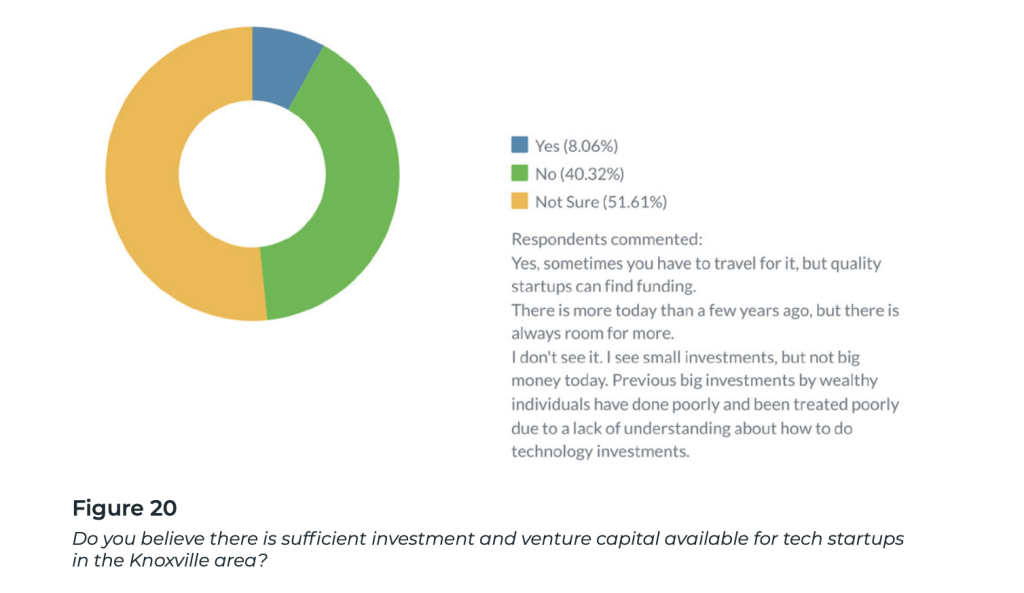
KTech’s report offers a nuanced take on Knoxville’s entrepreneurial ecosystem, which is that founders have strong early-stage support, but a capital gap that is pushing high-growth companies out of the region.
Only 8% of survey respondents believe there is sufficient venture capital available for tech startups in the Knoxville area.
The early-stage infrastructure is genuinely strong. for example:
- The Knoxville Entrepreneur Center has supported more than 90 companies that have collectively raised over $150 million.
- Innovation Crossroads at Oak Ridge National Laboratory has supported more than 50 startups, helped create over 300 jobs, and enabled more than $300 million in follow-on funding.
- And, companies that have undergone programming in the Spark Innovation Center have raised $129 million in non-dilutive funding, and over $44 million in equity investments to generate more than $29.9 million in sales revenue.
Co-working spaces like 121 Tech Hub also provide a strong sense of community in the early days.

“These initiatives speak to the idea of radical collaboration, and when we work together, we can grow better outcomes, Kittrell said.
But once a company is ready to scale, the resources thin out, according to the report.
What needs to happen next
The report is clear that Knoxville’s challenge is not a lack of assets — it’s a lack of coordination between those assets. Across workforce, technology, and entrepreneurship, the findings point to the same prescription: deeper collaboration between employers, educators, policymakers, and investors, with shared metrics to measure system-wide outcomes.
For example, Oak Ridge is building an identity around nuclear innovation, Knoxville is generating interest in quantum, and the broader East Tennessee business community is leveraging AI capabilities to improve workflows and efficiencies.
“AI, quantum, and advanced energy are key opportunities for Knoxville’s tech industry. We are uniquely positioned at the center of these three areas,” Kittrell said. “But, we have got to, as a community, and systemically, identify how we leverage those resources and the opportunities.”
Part of the report also examined existing infrastructure to support the growth of a tech-enabled ecosystem. Kittrell said understanding that side of the equation is important to understanding the bigger picture.
“Infrastructure planning requires coordination between public and private partners to ensure investments benefit the surrounding communities and support equitable access to essential resources and critical infrastructure across the region,” the report said (PG.24).
In short, the Knoxville region has significant innovation potential but needs stronger systems, spanning workforce development, capital access, infrastructure, and research commercialization to fully realize it.
Achieving that will require coordinated collaboration across employers, educators, policymakers, and investors to turn existing strengths into lasting, nationally recognized economic and tech leadership.
You can read the full KTech State of the Union Report here.
Like what you've read?
Forward to a friend!