


Quantum roundup: What in the world is happening with quantum in Tennessee?
What is quantum? Why does it matter? And, why is Tennessee doubling down on its efforts surrounding this industry?
There have been talks about quantum, projected economic impacts, and technology acceleration in the past few years in Tennessee, but it seems that in the past few months, the frequency of those conversations has become more abundant.
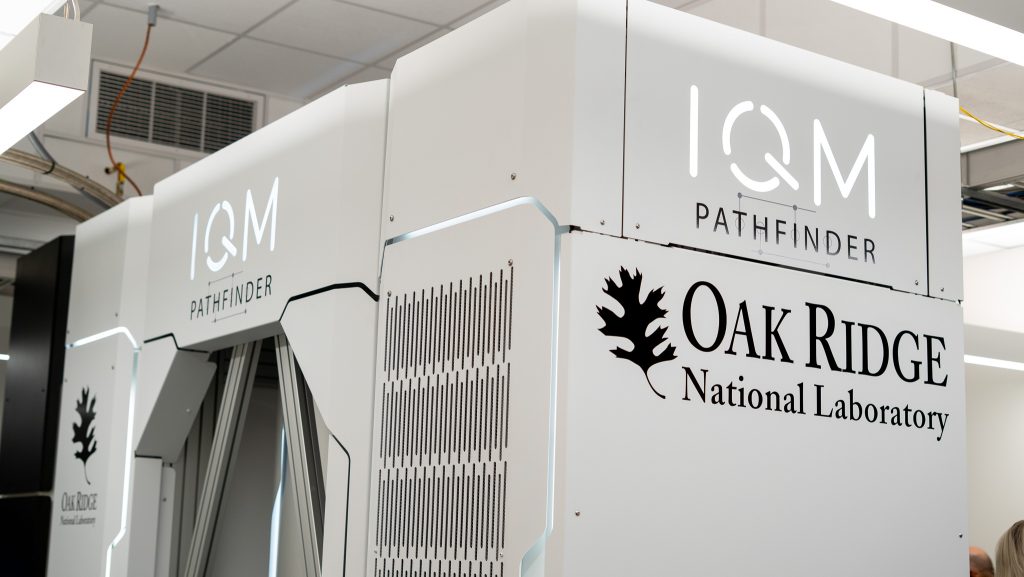
For example, on Tuesday last week, we shared a story from Oak Ridge National Laboratory about the 20-qubit quantum computer, Pathfinder, which will serve as a testbed for the lab to integrate high-powered computing (HPC) with quantum.
Then, immediately after, the founder of Quantum Coast Capital, Matt Cimaglia, traveled to hold a quantum conversation event at the University of Tennessee Research Park in Knoxville. Part of which touched on the newly announced K-Quantum Accelerator and Quantum Foundry.
And on Thursday, the Company Lab (CO.LAB) hosted a Quantum in Action webinar, with support from LaunchTN, the Tennessee Advanced Energy Business Council (TAEBC), the Chattanooga Quantum Collaborative (CQC), and IonQ.
In this story, we plan to break down some of the key initiatives that we have covered in Teknovation to provide you with a broader outlook on where our region is headed, regarding quantum computing, networking, and sensing.
How does quantum work?
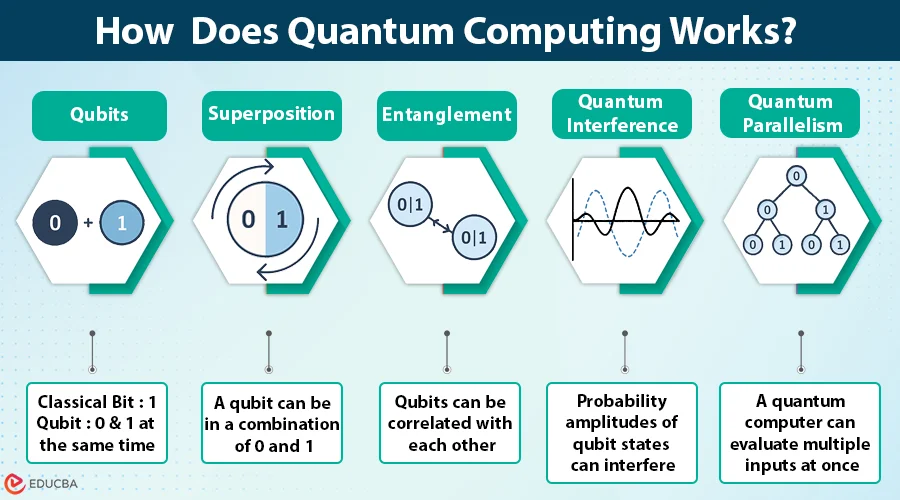
Normal computers operate with bits, which are either 0 or 1. Quantum computers use qubits, which can be 0, 1, or both at the same time (superposition), or somewhere in the vast space between. Qubits can also be linked (entanglement), so the behavior of one affects the other. This allows for much faster processing speeds and the ability to solve complex problems quickly.
As a positive example, in logistics, quantum could be utilized to find the most efficient routes for a fleet of thousands. Or, as a realistic bad-actor example in cybersecurity, quantum could be used to crack complex codes in seconds, which means quantum-level defense would be needed to prevent attacks.
“We see a landscape where quantum computers are going to work very closely with these larger supercomputers,” said Ryan Harring with IonQ at the Knoxville quantum conversation event. “Quantum computers will not replace classical computers but will work alongside them to solve complex problems.”
Understanding the State’s investment in quantum
The state of Tennessee pledged $43 million to the Tennessee Quantum Initiative, which Governor Bill Lee said is to help establish Tennessee as the global epicenter of quantum computing and advanced technology.
And that money has already started to roll out supporting efforts across the country.
During the quantum conversation in Knoxville, IonQ’s Harring said he believes quantum investment is important because it has the potential to impact countless industries.
“If we look at the number of technology spaces over the next 10 years, we’re talking about unlocking over a trillion dollars in economic impact. This is something that’s got the attention of a lot of industries,” Harring said.
In line with what Harring said, according to the McKinsey Quantum Technology Monitor 2026, quantum computing alone could create up to $2.7 trillion of economic value by 2035 through the commercialization of new use cases.

And there’s a specific reason why quantum companies like IonQ are investing in a presence in Tennessee.
“A lot of the work that’s being done in quantum is being done at the national labs, and luckily, we’re close to ORNL, the place that is one of the best in the world at advancing quantum computing,” Harring said.
Understanding public/private investment in quantum
Channeling the words of Cimaglia, the founder of Quantum Coast Capital, and an investor in a whole portfolio of early-stage quantum startups, right now, “quantum is an asset class.”
The general predictive consensus is that practical, commercially useful quantum computing will arrive around 2030. Cimaglia said this means that investors, private corporations, and government partners should bet on the industry as a whole rather than any single startup.
“There’s a high probability that a majority of where we’re investing today is going to end up getting acquired in the next few years, I mean, just look at IonQ’s acquisition strategy,” Cimaglia said. “Innovative industries like quantum are areas where you have to be patient as an investor.”
A briefing on quantum in Knoxville
As Teknovation’s Lindsay Turner wrote at the end of May, the Knoxville Quantum Accelerator, known as K-Quantum, is being launched by the University of Tennessee alongside partners such as IonQ, ORNL, the Tennessee Valley Authority, and CGI. And, the Quantum Foundry will provide a physical space for K-Quantum to operate.
K-Quantum Accelerator will focus on building companies
K-Quantum will add up to 10 new faculty members with expertise spanning quantum hardware and software over the next four years. UT-ORNL Governor’s Chair for Quantum Devices Deep Jariwala, an expert in quantum devices, will also join UT from the University of Pennsylvania in January 2027.
The K-Quantum Accelerator will also focus on turning quantum technologies into commercially viable startups to advance the region’s economy.

The Quantum Foundry will be a demonstration facility for these technologies
“We’re really excited about our 5th building in the Research Park, which will sit across from the Institute for Advanced Materials Manufacturing (IAMM). We’re calling the building the Quantum Foundry, and it will be a multi-tenant facility,” Malone shared.
He said the 100,000 square foot building is currently in the design phase and will also link to the planned Maplehurst Innovation District downtown.
“We view the Maplehurst Innovation District as a showcase space. So, students, faculty, and community members could better understand quantum, how it works, and why it’s important,” Malone explained.
Other Knoxville- Oak Ridge quantum initiatives worth mentioning
- ORNL has deployed IQM’s Pathfinder 20-qubit computer to begin integrating quantum with high-powered computing.
- ORNL operates the Quantum Science Center, spearheaded by Travis Humble.
- UT operates the Tennessee Quantum Center.
- Startups that have come through the Innovation Crossroads program are shaping early conversations about the commercial viability of quantum: AtomQ, founded by Kevin Roccapiore, and Qubit Engineering, founded by Marouane Salhi.
A briefing on quantum in Chattanooga
There’s so much happening in Southeastern Tennessee regarding quantum, which is largely anchored by EPB, IonQ, and the University of Tennessee at Chattanooga (UTC).
The pioneering efforts of EPB
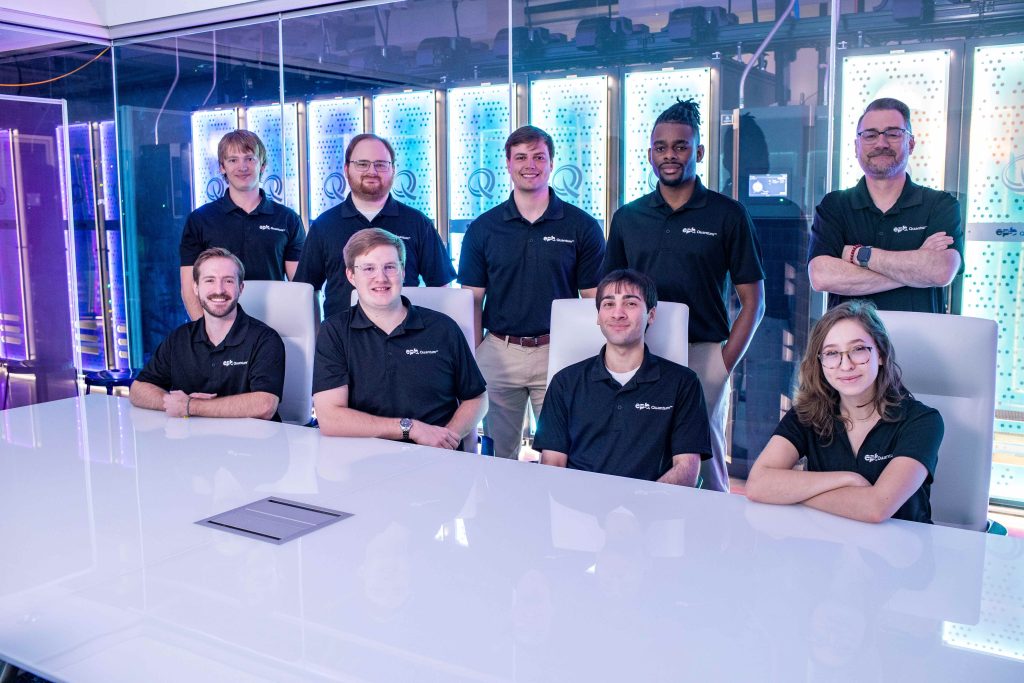
Last year, IonQ announced a $22 million deal with EPB to establish Chattanooga as the first quantum computing & networking hub in the nation. And, since that announcement, organizations across the city have stepped up to create talent, workforce, and commercial pipelines to support the technology.

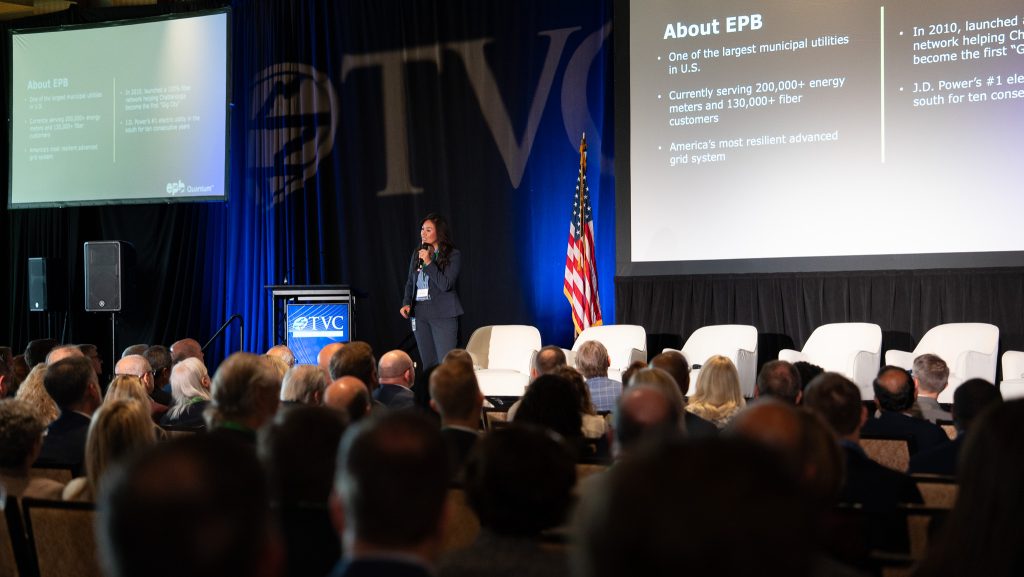
For example, EPB and Vanderbilt University launched the Institute for Quantum Innovation in Chattanooga to accelerate quantum technology breakthroughs and commercialization.
Additionally, in December 2025, the EPB board approved a $9 million quantum incentive fund, which will, in part, go towards deepening the partnership between Chattanooga’s public utility and the university. Over a period of five years, EPB will give UTC more than $3 million in matching grants to add hundreds of faculty, staff, and students to focus on quantum.
The pioneering efforts of UTC
UT launched the UTC Quantum Center to train a quantum-ready workforce, offer degree pathways, and establish a partnership with ORNL. Also, the UTC Quantum Initiative has established a quantum node connected to the EPB Quantum Network.
Additionally, in September 2025, UTC was awarded a $1.33 million planning grant from the National Science Foundation (NSF) to develop a blueprint for a QuantumGrid Innovation Hub in Chattanooga.
Other Chattanooga quantum initiatives worth mentioning
- The Chattanooga Quantum Collaborative (CQC), which has been around for years now, acts as the nonprofit arm that aligns local research initiatives with industry and education to drive economic growth and workforce development.
- The CQC helped launch the nation’s first paid 12-week quantum pre-apprenticeship to train early- and mid-career professionals.
- The Company Lab (CO.LAB) has opened a quantum accelerator to discover, incubate, and connect quantum startups to the ecosystem.
A briefing on quantum in Middle Tennessee
Of course, Vanderbilt’s agreement with EPB to launch the Institute for Quantum Innovation in Chattanooga is an initiative shared with the Nashville-based university. However, Vanderbilt also hosted a quantum industry forum in April to develop thought-leadership around the topic.
MTSU invests in quantum readiness
Other universities in the area, like Middle Tennessee State University (MTSU), have also sought and landed partnerships with ORNL to establish quantum programs. Thanks to a Department of Energy (DOE) RENEW award, MTSU established the TN-QuMat Consortium to focus on quantum materials, high-performance computing, and federally aligned quantum workforce pipelines.
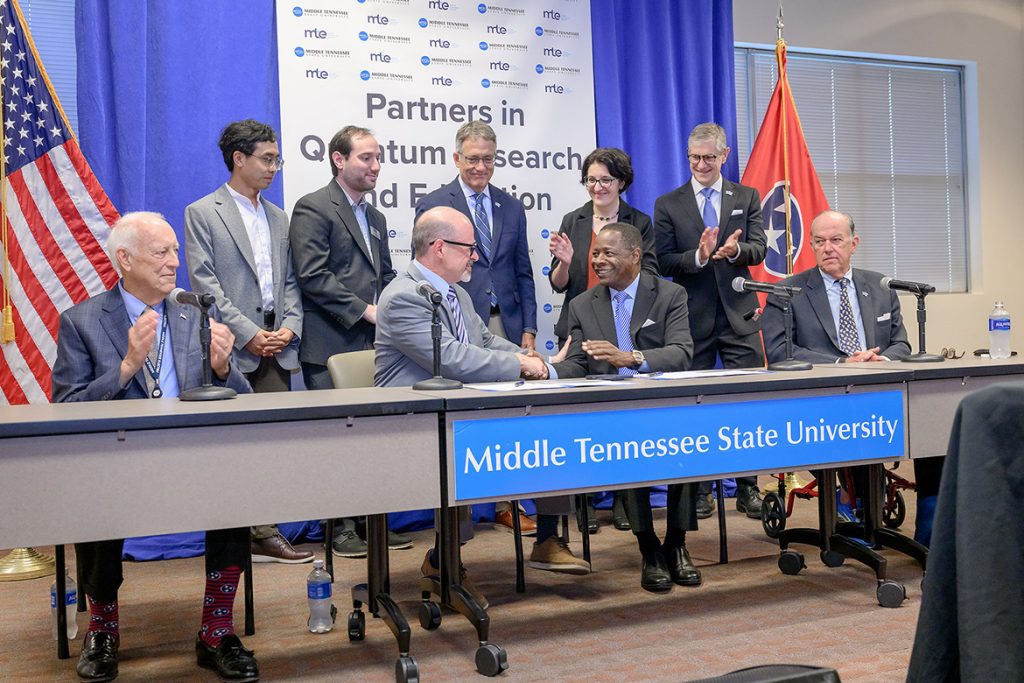
Thanks to $9 million in federal funding, MTSU launched the Quantum Research Interdisciplinary Science and Education (QRISE) center. Shortly after, MTSU and Middle Tennessee Electric signed a memorandum of understanding (MOU) to advance quantum research, a tech hub in the region.
How can the whole state work together?
Going back to the quantum conversation in Knoxville on Tuesday, Brett Malone, the President and CEO of the UT Research Park, said statewide partnerships are critically important to accelerating the advancement of quantum.
“When you think about building a statewide quantum network, the connectivity of our campuses – like Knoxville with Chattanooga and with ORNL. Long term, we’re all going to be part of a broad network,” Malone said. “It’s best if we all work together to achieve those results.”
Like what you've read?
Forward to a friend!