

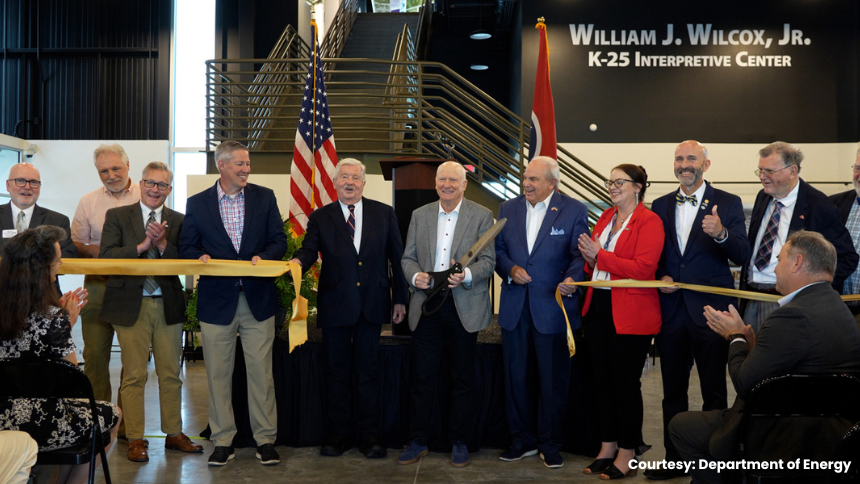
New Interpretive Center opens at K-25 site, offering picturesque views of Oak Ridge’s atomic legacy
The center is named in honor of William J. Wilcox Jr., Oak Ridge’s first official historian and a longtime advocate for preserving the city’s atomic heritage.
A new chapter in Oak Ridge’s storied past was unveiled this week with the opening of the William J. Wilcox Jr. K-25 Interpretive Center, a facility that offers the public a panoramic view of what was once the world’s largest building under one roof.
Perched above the 44-acre footprint of the former K-25 Building, the center provides a long-awaited vantage point of the mile-long structure that played a pivotal role in ending World War II. Constructed in 1943 as part of the Manhattan Project, K-25 was one of five massive gaseous diffusion uranium enrichment facilities that helped fuel the U.S. nuclear arsenal.
The new center is located at the East Tennessee Technology Park (ETTP), formerly the Oak Ridge Gaseous Diffusion Plant, and marks a milestone in the decades-long transformation of the site from a restricted federal complex to a hub for innovation, conservation, and economic development.
The center is named in honor of William J. Wilcox Jr., Oak Ridge’s first official historian and a longtime advocate for preserving the city’s atomic heritage. Wilcox, who arrived in Oak Ridge during its earliest days, eventually became technical director for all R&D programs at the plant. He spent more than four decades documenting and sharing the site’s history with future generations.
Inside the center, visitors can explore exhibits and a detailed scale model of the K-25 Building, offering a sense of the sheer scale and complexity of the original facility. The elevated design of the building allows for a full view of the site’s footprint—something that wasn’t possible from ground level after the building’s demolition in 2013.
The interpretive center fulfills a commitment made by the U.S. Department of Energy’s Oak Ridge Office of Environmental Management (OREM) in 2012 to commemorate the site’s historical significance. That agreement also included the construction of the adjacent K-25 History Center and the preservation of the historic Alexander Inn.
The opening of the interpretive center is the latest milestone in a 30-year effort to clean up and repurpose the ETTP site. OREM and its cleanup contractor UCOR have completed demolition and soil remediation across the complex, making it the first fully remediated gaseous diffusion site in the country.
As cleanup progressed, land was gradually transferred to the community for redevelopment. To date, more than 1,800 acres have been made available for new businesses, conservation areas, and public access.
That land is now attracting billions in private investment—including Oklo’s recently announced $1.7 billion nuclear fuel recycling facility—and helping to position Oak Ridge as a national leader in clean energy innovation.
Like what you've read?
Forward to a friend!