

UTK’s College of Emerging and Collaborative Studies hosts third annual ‘Career Catalyst’ and announces new startup incubator
More than 100 leaders from 80-plus organizations attended the 2025 edition, and this year's event drew a similarly strong crowd.
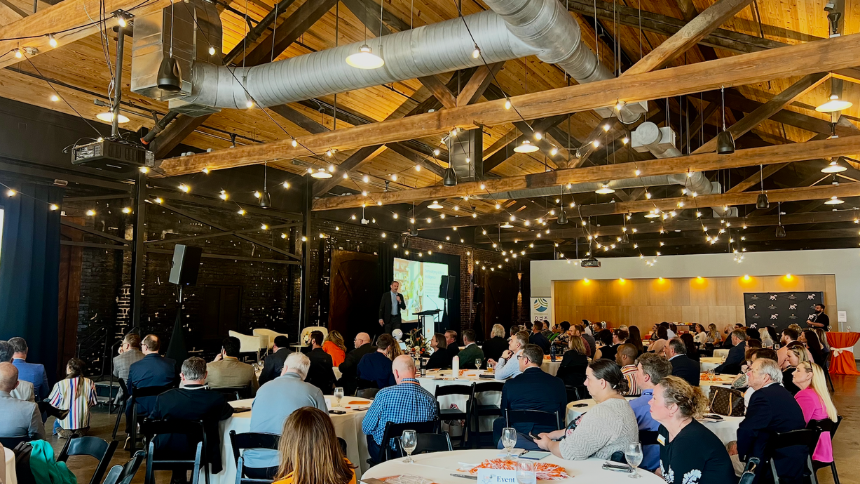
The University of Tennessee’s College of Emerging and Collaborative Studies (CECS) brought together a room full of leaders from industry, government and higher education Thursday afternoon at the Jackson Terminal in downtown Knoxville for its third annual “Career Catalyst” event.
Co-hosted with the Knoxville Technology Council, the afternoon was packed with strategic conversations that focused on the future of work in a technology economy and a “tech toy room” filled with robots and immersive experiences.
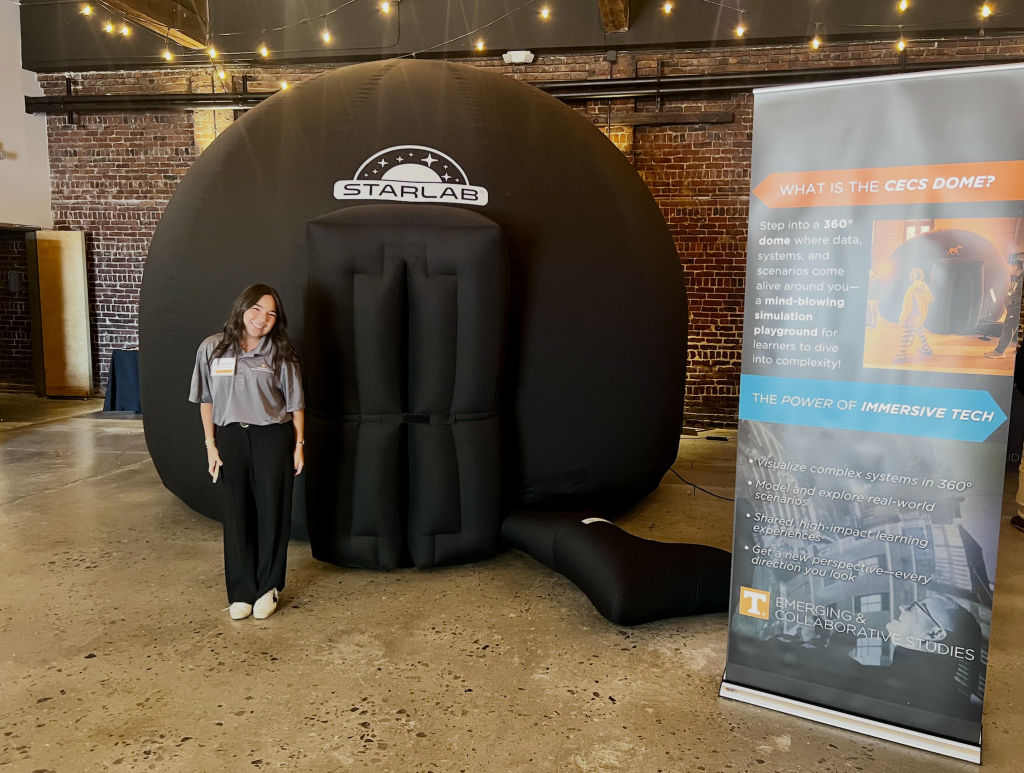
Below is a closer look at a few of the day’s conversations.
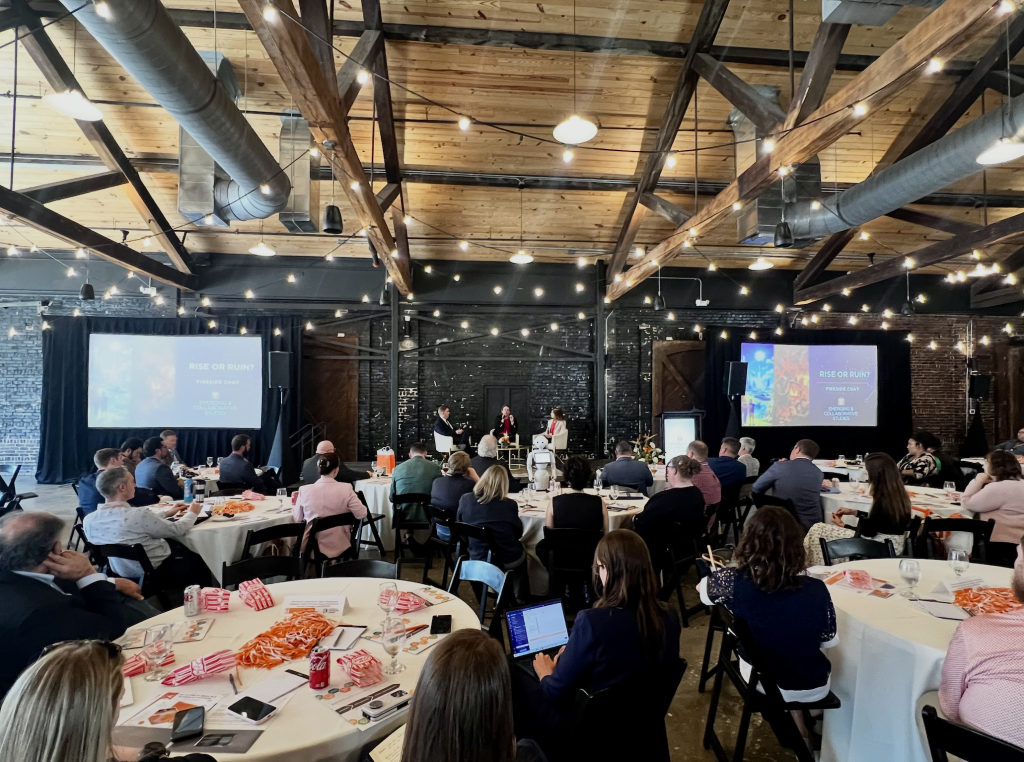
Fireside chat: Rise or ruin?
This panel featured:
- Steve Scully of Sirius XM as the moderator.
- Kate Harbath, founder of Anchor Change and a former senior executive at Meta who oversaw global elections policy and governance.
- Dr. Hava Siegelmann of UMass Boston, a researcher in AI and computational neuroscience.
Much of the conversation centered on the tension that AI feels both unavoidable and risky to talk about openly.
“If you use AI, it’s cheating, but if you don’t use it, you’re going to lose your job. People don’t know what to do,” Harbath said. “There’s not a lot of places to have a conversation about the ethical way to use these tools, because people are really afraid that if they talk about it online, they’re going to get canceled.”
To overcome this, Harbath’s advice was to start now, and to start small.
“You don’t have to use it for work or school right away. But just start to learn how to use the tools so you can start to get up to speed,” she said.
Looking further ahead, Harbath pointed to the generational divide that will define AI adoption. For example, her 17-year-old nephew is just now starting to learn AI tools. On the other hand, her one-year-old niece is likely to grow up with a personalized AI tutor and AI-powered toys as a matter of course.
Siegelmann added her perspective.
“Believe it or not, I don’t think we are in an AI revolution or age just yet. But we are in an AI language model revolution. There is a big difference,”she noted. “For elementary school, I don’t know that it’s very smart to introduce it, because we want children to be able to read, summarize and write for themselves.”
The conversation also surfaced a cultural problem in how failure is treated. Harbath argued that students’ reluctance to engage without AI often stems from a fear of being wrong.
“We as a society have not rewarded failure, and students are so scared about being wrong,” she said. “We need to think about how we build a culture where failure is a learning experience, not something to be ashamed of.”
Siegelmann echoed the point, drawing on an observation from a startup convention she recently attended.
“They had people from Israel, which is considered a startup nation,” she said. “To them, if you were involved in five startups, that doesn’t mean you have had five failures. You have five experiences.”
The overall theme was that AI cannot be viewed as all “rise” or all “ruin.” Like with anything, it needs to be used in moderation with boundaries, and it is up to teachers, policy-makers and community leaders to ensure those boundaries exist.
“We need to equip students with the skills and provide guardrails about where they can or cannot use AI in the classroom,” Harbath said. “Finding more ways to have those conversations is going to help bring the fear thermometer down and prepare people for a world that is going to be rapidly changing.”
Workshop: CECS innovation exchange
The afternoon closed with a shift from conversation to collaboration.
Faculty and industry leaders joined a topic-driven workshop to generate bold ideas for curricula, partnerships and experiential learning across seven focus areas: applied AI, applied cybersecurity, data science, gamecraft, human interaction with intelligent systems, medical sciences and sports analytics.
The workshop format has a track record of producing real results. Past CECS innovation exchanges have inspired industry capstone projects including an automated data pipeline for engineering at Volkswagen, an AI-driven community threat monitoring system for Blue Cross Blue Shield and a government ERP market analysis for CGI.
Special announcement: CECS launches startup incubator
The event ended with a significant announcement for Knoxville’s startup community.
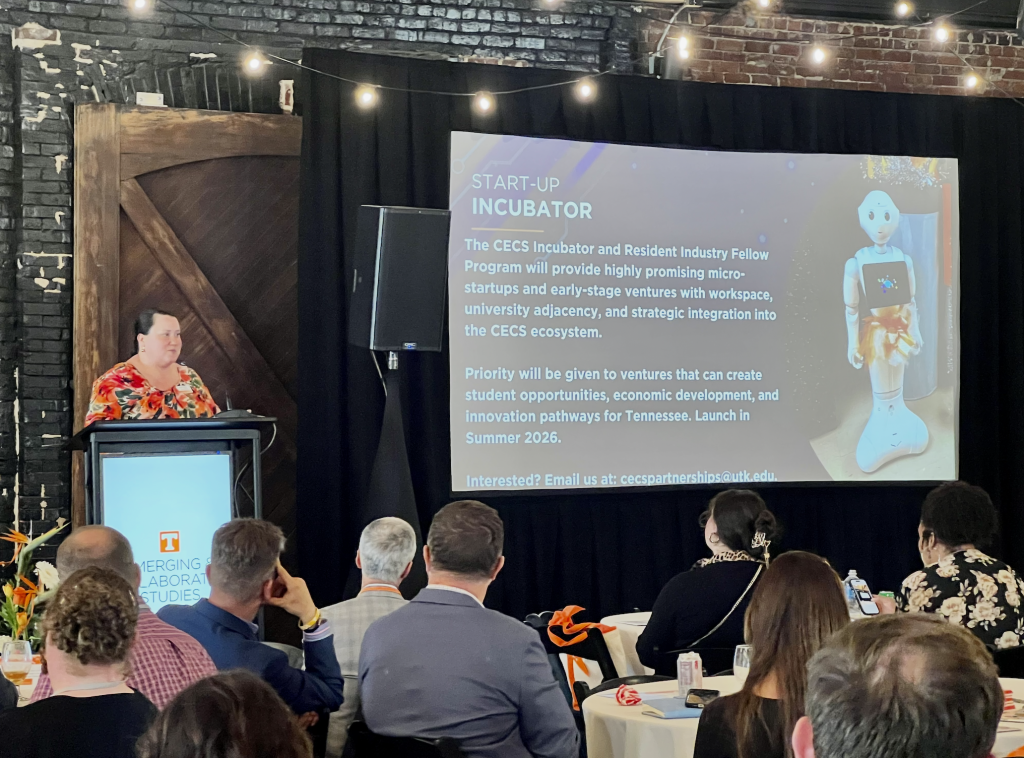
CECS unveiled plans for the CECS Incubator and Resident Industry Fellow Program, set to launch in summer 2026. The program will provide highly promising micro-startups and early-stage ventures with workspace, university adjacency and strategic integration into the CECS ecosystem.
Priority will be given to ventures that create student opportunities, economic development pathways and innovation opportunities for Tennessee.
Those interested in applying should email the CECS Partnerships team.
Like what you've read?
Forward to a friend!