

PFAS in your drinking water? Aquafer Technologies might be a lifesaver
As the EPA prepares to fine utilities that fail to filter forever chemicals, Aquafer Technologies is scaling up a solution it says beats anything on the market.
More than 9,700 water utilities across the United States are currently out of compliance with the coming federal limits on per- and polyfluoroalkyl substances, known as PFAS or “forever chemicals.” By 2031, the Environmental Protection Agency (EPA) will begin enforcing those limits, and utilities that fail to act could face fines of up to $70,000 per day. That leaves a lot of water districts looking for a solution.
A Knoxville startup says it’s ready to provide one.
Aquafer Technologies has set up shop at the University of Tennessee Research Park’s Spark Incubator and is developing a water treatment material that it says outperforms and outlasts anything currently on the market.
Fuhar Dixit, the company’s founder, said they have five paid pilots lined up for 2026, including a phase two PFAS trial with the Orange County Water District in California.
“All these almost 10,000 utilities are going to have to find a solution. Right now, about 70-80% of the materials solutions are being made overseas in places like China,” said Marton Krivan, Aquafer’s manufacturing lead. “We hope that our solution, made in Tennessee, will become the U.S. industry standard. We believe it is superior to everything else we’ve seen on the market.”
Discovering the solution
Dixit discovered the technology during his doctoral research at the University of British Columbia in Canada. He later moved to Silicon Valley, where he worked as a global entrepreneur in residence at UC Berkeley before relocating to Knoxville to build the company inside UT’s incubator.
Now, Dixit is also a professor in UT’s Department of Civil and Environmental Engineering.
“This was a perfect place to build a manufacturing unit for these kinds of materials, because all the resources – like Spark– and others were here,” Dixit said. “Tennessee is also known for materials discovery and materials research.”
The problem of PFAS
The cleaning process for water before it comes through your sink spout or showerhead is extensive. Even still, the scope and scale of the PFAS problem is easy to underestimate.
The chemicals are colorless, odorless, and widespread. PFAS compounds are found in everything from Teflon cookware to food packaging. The part that concerns health officials, physicians, and scientists is that these chemicals don’t break down in the environment or the human body.
And as of 2023, Research by the USGS showed nearly half of America’s drinking water supply is contaminated.
“If you had a swimming pool full of water, just one drop of these PFAS would be enough to exceed safe limits,” Krivan explained. ” They’ve been linked to cancer, immune suppression, and a range of other health disorders.”
Most filtration systems on the market target only a handful of the compounds currently under federal scrutiny, such as perfluorooctanoic acid (PFOA) and perfluorooctane sulfonic acid (PFOS). But, Krivan said, targeting just these two chemicals is only mitigating a small portion of the problem.
How Aquafer changes the approach
“We target the whole spectrum, not just the very specific ones that are getting regulated by the government,” Krivan said. While the microscope may be on the two, the EPA states that there are actually thousands of PFAS compounds in existence – some of which are even more dangerous.
Dixit said the patent-pending super absorbent material he invented lasts roughly 10 times longer than activated carbon, which is the current industry standard. He predicts Aquafer could help utility companies cut operating costs in half. If this claim pans out, it is a huge deal.
PFAS can be bought for less than $100 per pound, yet that same amount costs water treatment facilities and utilities more than $2.7M to remove and destroy.
Additionally, Aquafer holds an NSF protocol certification, which is the standard quality credential for drinking water treatment products.
Relocating to Tennessee
Dixit recently moved to Tennessee from California, in large part because of the resources available in the East Tennessee area. Shortly upon arrival, he hired Krivan through the University connection and the Spark Scholars program.
“We met and ended up talking for a long time,” Krivan said. Dixit agreed, adding, “We’ve been a really good team.”
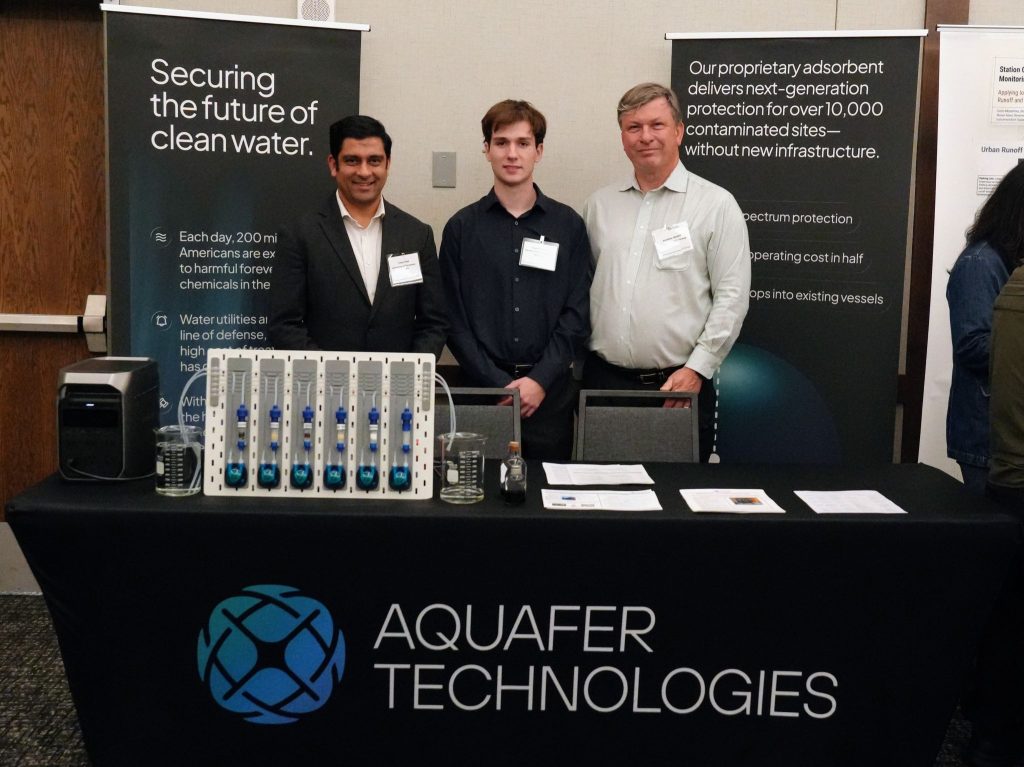
Now, Aquafer Technologies is moving into the brand new lab space at UT’s Center for Precision Health building on the UT Research Park campus. They are one of the first companies to occupy the space.
Krivan said that the lab space will allow them to ramp up production from just a few liters to about 40 liters (10 gallons per day). He said this production improvement is game-changing and will allow them to land additional pilots and customers.
While drinking water is the first avenue these two are pursuing, Dixit said it’s not the only outlet they have for his material discovery.
“We have identified several additional markets with serious PFAS contamination issues, including defense sites, airports, semiconductor manufacturing facilities, and lithium-ion battery recycling operations,” Dixit said. “All these are loaded with PFAs, and all of them would need a cleanup.”
He said that “north star vision” is what keeps Aquafer fueled day-to-day.
You can connect with Fuhar Dixit here.
Connect with Marton Krivan here.
Learn more about Aquafer Technologies.
Like what you've read?
Forward to a friend!