
From fuel to fabrication | How ORNL’s $27 million partnership with Kairos Power will advance the Hermes project
“ORNL helped develop and enhance the fuel. So, in this partnership, we come in with our expertise and history," said Chris Petrie, the interim section head for nuclear fuel development at the National Lab.
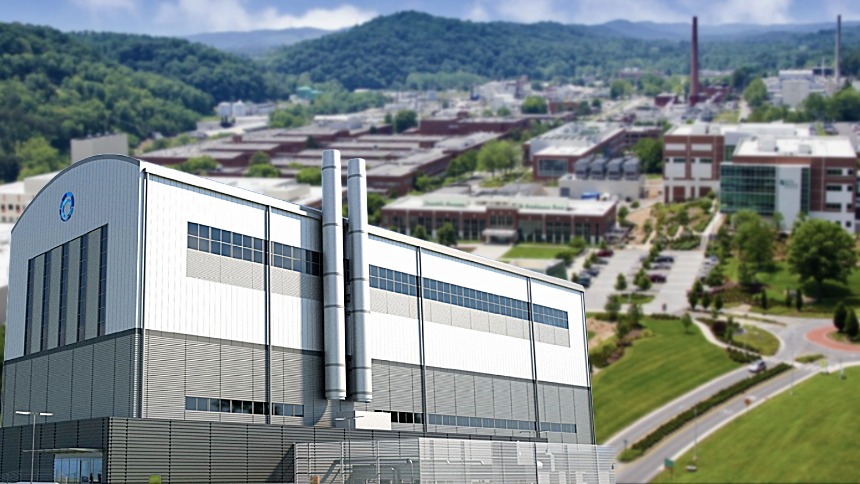
Oak Ridge National Laboratory (ORNL) has shaped nuclear innovation for more than 80 years. Now that legacy is fueling a new chapter as Kairos Power and ORNL launch a $27 million partnership to advance the next generation of molten salt reactors.
The collaboration builds on a long history of nuclear research in Oak Ridge. Scientists at the lab developed the world’s first operational nuclear reactor in 1943 and produced the first nuclear‑generated electricity less than a decade later.

Today, that foundation is helping accelerate cutting‑edge work on tristructural-isotropic fuel and salt‑cooled reactor technology, which was developed and enhanced at the lab several decades ago.
Chris Petrie is the interim section head for nuclear fuel development at the lab. He has been with ORNL for 12 years, spending his whole career in the nuclear sector.
Petrie said he is amazed by what he’s seen from the lab, Kairos, and from partners across the area.
“There’s really been no more exciting time than now for nuclear, especially in East Tennessee,” he said.
How ORNL and Kairos plan to work together
Getting Hermes up and running is the north star for Kairos and the National Lab. The $27 million partnership is a testament to that commitment.
Fuel efficiency and reliability are part of the equation
Petrie said ORNL will assist with strategic advising around TRISO fuel fabrication, characterization, quality control, and waste management.
“This fuel was developed for a reactor that was cooled by a gas, and gases can only remove so much heat. Because of those limits, you have to operate at a lower power density,” Petrie said.
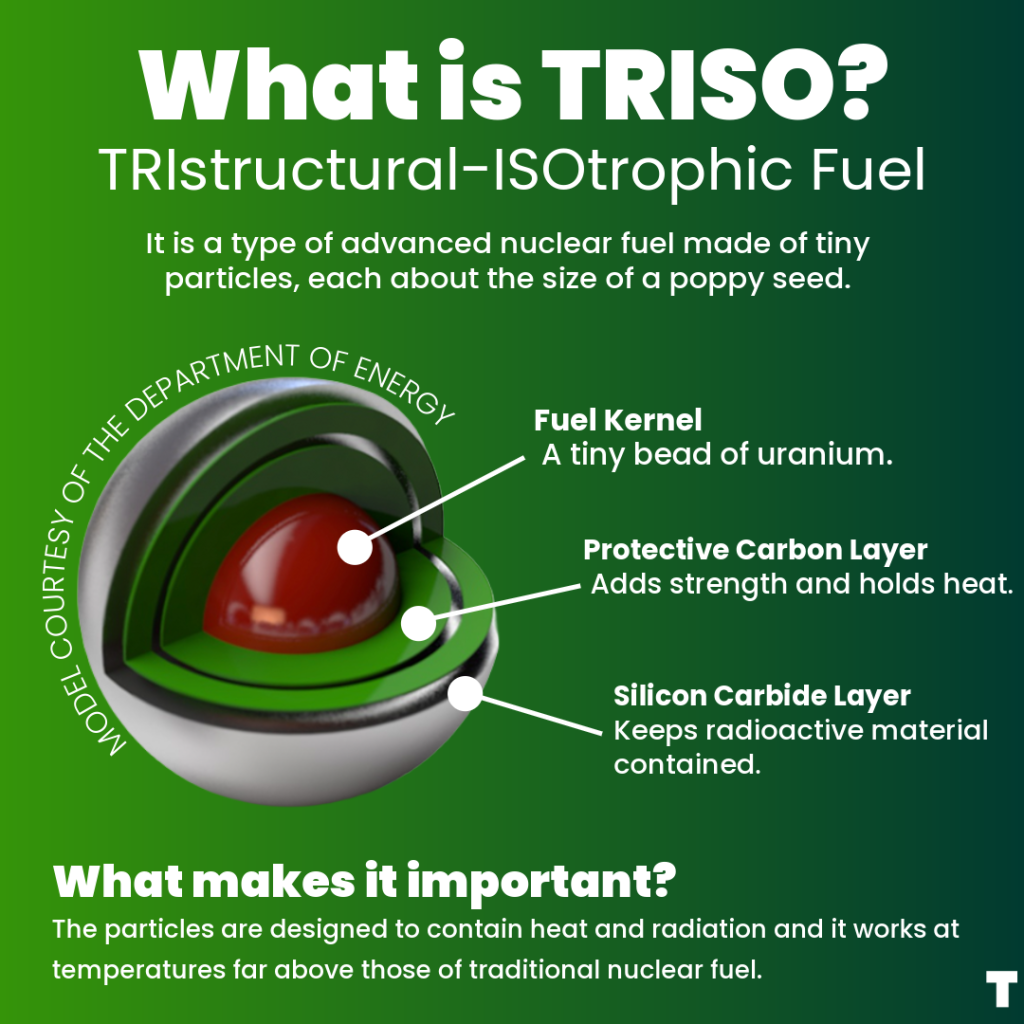
Kairos has taken an interesting approach to this hurdle. They’re taking TRISO fuel, which has been under development for decades, and want to use molten fluoride salt coolant as part of their fluoride‑salt cooled high‑temperature reactor (KP‑FHR) design.
This would allow for their Hermes reactor to operate at a much higher power density than nuclear scientists previously thought possible.
ORNL demonstrated the proof-of-concept and performance of the world’s first molten salt reactor 60 years ago. Since then, ORNL has helped nurture the continued development of molten salt reactor technology, which uses salt rather than water as the primary coolant.
“ORNL helped develop and enhance the fuel. So, in this partnership, we come in with our expertise and run tests. We fabricate the fuel and develop specifications for different reactor applications. Then, we’ll say – Here are some of the things you might want to watch out for,” Petrie said.
Servicing solutions are another side of the equation
“This reactor is going to operate at much higher temperatures with the addition of cooling salt,” Petrie explained. “Because of those conditions, you have to be able to service the inside of the reactor remotely, without sending a human inside.”
Kairos is working with ORNL to help develop unique technologies that can service the reactor at high temperatures, in tight quarters, and with little space for error.
“You’ve got to go 20 feet down with a long operating tool and a heavy robotic arm. Those arms need to have a camera so the operators have eyes. The arm needs to be able to manipulate things – cut, inspect, align, weld, leak test, all the above, and more,” Petrie explained.
To begin assembling such an advanced technology, Kairos is leveraging ORNL’s Manufacturing Demonstration Facility at Oak Ridge to 3D print components that they can’t source commercially
While ORNL is primarily serving as a strategic advisory partner, Petrie said there is potential for the lab to help fabricate some of the key materials, run simulations, tests, and other physical experiments to prove the viability of both the cooling salt applications and the remote service repair contraption.
This will be the fourth partnership between the two entities since 2020.
In addition ot the partnership with ORNL, the DOE is investing up to $303 million of risk reduction funding in Kairos Power’s Hermes demonstration reactors under the Advanced Reactor Demonstration Program to mature the company’s molten salt reactor design.
Learn more about Kairos Power in Tennessee.
Like what you've read?
Forward to a friend!