

An update on OTTO: The sustainable home designs of the future
Through OTTO, founder Maged Guerguis is solving key challanges in the construction industry like unpredictability, supply-chain gaps, costs changes, and schedule delays.
About one year ago, we featured Maged Guerguis in Teknovation. At the time, he was a University of Tennessee, Knoxville, architecture professor with an idea for a business.
Today, he is the full-fledged founder of OTTO, which is a prefabrication materials and manufacturing company.
“We started OTTO to improve the construction process. Traditional home building can be slow, full of overruns and delays, and creates a huge amount of waste,” Guerguis explained.
Guerguis said there’s a more efficient and sustainable way to do this. He’s spent the past two years developing it.
His once-theoretical, now-proven research at UTK revealed a process through which material could be uniquely designed for high-stress areas in a structure. Guerguis said this design is based on “biomimetic principles found in nature,” which maximize structural performance, minimize weight, and drastically reduce waste.
“We’ve created something called the U-Panel,” he said. “Instead of building walls from scratch and leaving them out in the rain and mud, we build them in a factory setting, with insulation, and built-in spaces for wiring and plumbing. But it all comes in one piece.”
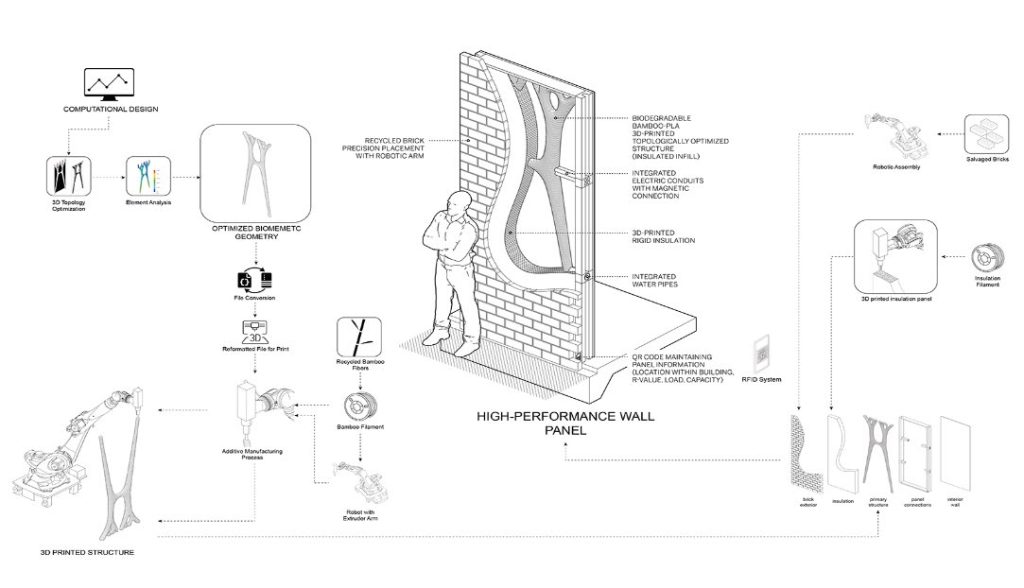
Learn more about the U-Panel here.
Using digital design and modern fabrication methods, Guerguis believes they can help homes and buildings go up faster, cheaper, and ready for inspections from day one.
As of right now, OTTO is 3D printing prototypes with the hope of having a working demo by the end of 2027.
OTTO Smart Homes
Guerguis said the U-Panel is not the only smart functionality he has innovated with OTTO. He is also focused on helping future U-Panel homes embed smart systems.
“All OTTO products, especially the final homes, will include a smart system that controls different sensors like tracking water usage, power usage, potential leaks, gases, and smoke detectors,” Guerguis explained.
An example scenario of how this could be useful is when a homeowner goes on vacation. What if a leak started? It could destroy valuable property and damage the home. Instead of finding out when you return from vacation, a homeowner with a smart OTTO system could be notified of the leak and turn off the main valve on their phone within minutes.
Guerguis said the smart system can also suggest to homeowners the optimal time to run their electronics to reduce energy consumption and avoid peak usage hours.
Beautiful design, accessible to all
“I dream that everyone should have access to good design,” Guerguis said. “We want to make smart homes available in the marketplace.”
Guerguis aims to have OTTO’s sustainable smart homes focus on the methods of construction, speed, and the predictability of cost.
“Going through the Spark Cleantech Accelerator helped me tremendously, because they kept asking, ‘What’s the problem I’m solving?’ And I realized that the big challenge in construction is unpredictability, change in costs, and delayed schedules. So, solving for that is our focus,” he said.
But, as an architectural designer at heart, Guerguis said “beautiful design” isn’t taking a backseat.
You can read more about Maged Guerguis and OTTO here.
Like what you've read?
Forward to a friend!