

Knoxville Founder Megan Quigley is reimagining accessible kitchen design
PrepSolo, the business idea that took home the win in Knoxville Entrepreneur Center's "What's the Big Idea?" pitch competition, is an affordable, modular kitchen system for wheelchair users and aging adults.
Megan Quigley did not grow up thinking she would start a business. But after years of navigating a world not built for her, the business idea found her.
And Knoxville’s startup community has welcomed her with open arms. Quigley, and her big idea behind PrepSolo, recently won the Knoxville Entrepreneur Center’s (KEC) “What’s the Big Idea?” pitch competition. PrepSolo will be an affordable, modular kitchen system for wheelchair users and aging adults.
A problem she knows firsthand
Quigley was born with Osteogenesis Imperfecta (OI), commonly known as brittle bone disease. This genetic condition weakens bone structure. As such, she uses a wheelchair and has spent her life encountering spaces that were not designed with her in mind, whether it be friends’ homes, restaurants or even her own kitchen.
“I really love to cook, but my kitchen is not built for me,” she said. “Everything is too high. It’s dangerous. I can’t reach most of my appliances. I want to help others, and when I think about how to do so, it’s natural for my mind to go to how I would have wanted to be helped as a kid,” said Quigley.
That frustration became the foundation for PrepSolo.
The product
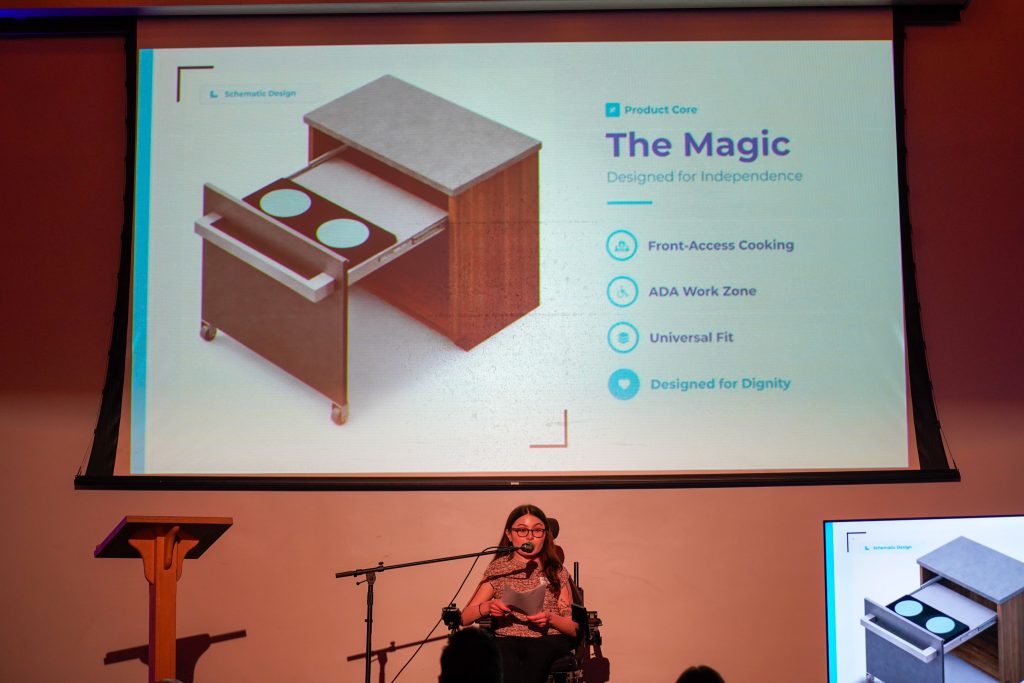
Most standard kitchens do not allow wheelchair users to pull up to a sink or stove. However, PrepSolo addresses that with a cabinet-mounted unit that pulls down to create essential knee clearance.
Quigley is targeting a retail price of $750 for the unit, a fraction of the cost of a traditional accessibility kitchen remodel. With the $490 billion U.S. disability market, she knows that the desire and plain need for a tool like this is there.
The $10,000 prize from KEC will fund early prototyping and further research and development. Her goal is to have a finished prototype by the end of 2026, followed by pilot installs.
She is already partnering with Amanda Furlow of DesignAF to ensure the product does not sacrifice aesthetics for accessibility, a tradeoff she says happens far too often with accessible solutions. She is currently seeking local manufacturing partners and architects to help bring their vision to life.
“PrepSolo, and other adaptive tools, are beneficial for not just disabled people, but aging populations, people who are temporarily injured and anybody who may just need it for physical ease,” Quigley said.
A natural yet reluctant entrepreneur
Quigley’s mother is the founder of Onrise, a well-known mental health organization for athletes. The idea of entrepreneurship was always in the household, but Quigley spent her high school and college years actively wanting to forge her own path.
Even so, her community-driven entrepreneurial instincts kept showing up. In middle school, she organized a school-wide event called Disability Day. She assigned classmates a physical disability for a full day and equipped them with the corresponding mobility devices like wheelchairs, crutches, noise-canceling headphones and blindfolds.
“The idea was that it would help open my classmates’ eyes to experiences that they don’t even think about, things that they take for granted. And then, treat people better or be advocates for accessibility,” she said.
It was not until after college that she connected the dots between impact and business.
“I didn’t really know that business could be so impactful until I started thinking about how it could help marginalized communities who are overlooked with these sorts of solutions,” she said. “When I realized there can be impact businesses and impact ventures, I thought that is a really cool thing, and realized that was what my mom was doing all along.”
An ode to Knoxville’s startup community
Quigley moved to Knoxville at age two and considers it home. She says the response after her KEC pitch was unlike anything she expected.
“I probably got 20 people’s phone numbers that night,” she said. “I was so shocked and thrilled at how many people were excited to talk to me. This is how I imagined a startup city should be.”
Like what you've read?
Forward to a friend!