

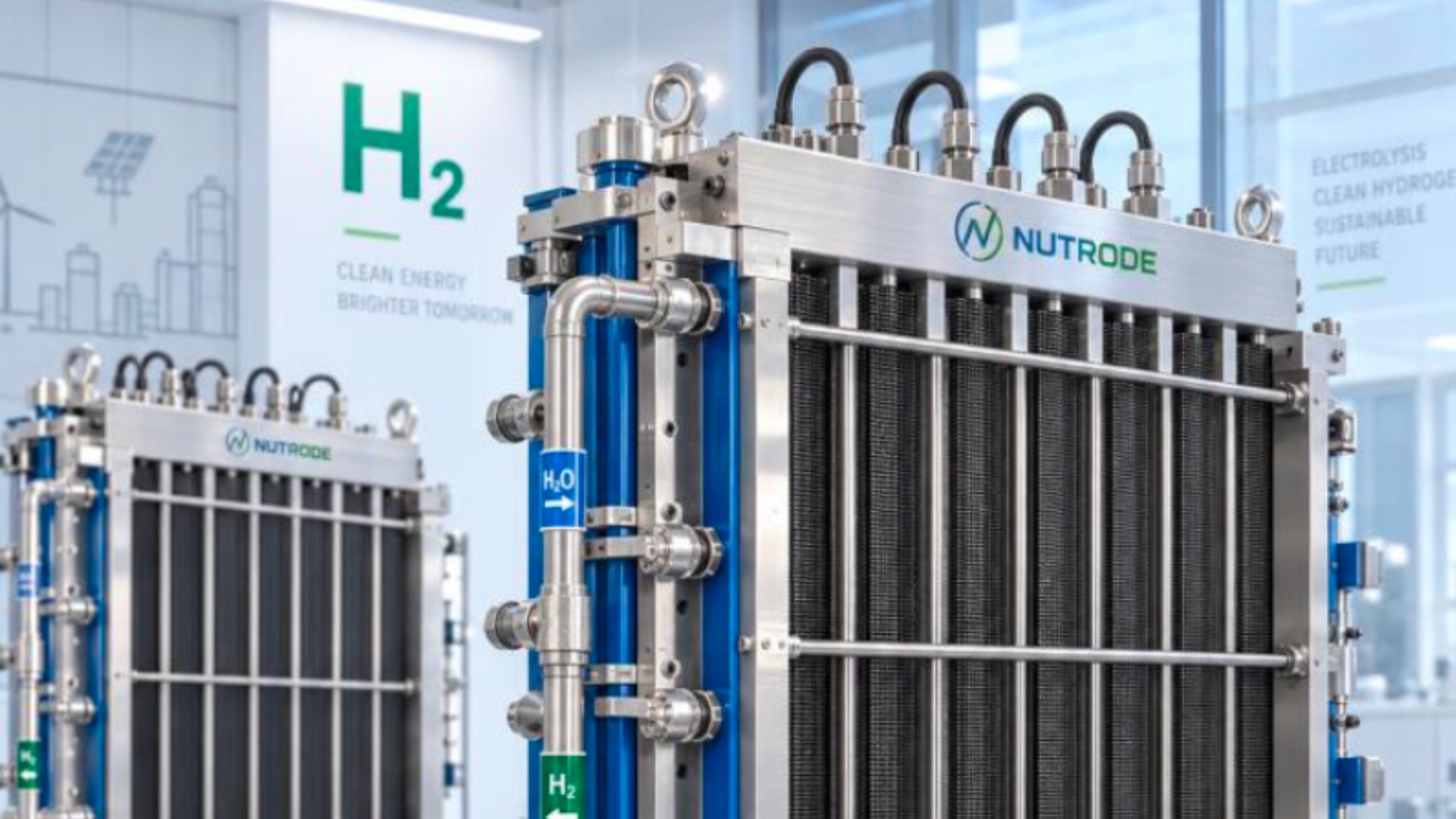
Knoxville startup Nutrode aims to cut electrode manufacturing costs by more than 90%
A Knoxville-based startup emerging from the University of Tennessee, Knoxville, is developing an innovative electrode manufacturing technology designed to reduce costs and improve the performance of electrochemical systems. We sat down with the company, Nutrode Inc.’s, Director of Research & Development Dr. Lei Ding.
Conventional electrode manufacturing often requires expensive materials and complex, multi-step processes that increase costs and limit scalability. Many electrochemical applications also demand highly active and durable catalysts, often requiring significant precious-metal loadings.
Nutrode, Inc.‘s technology aims to address these challenges by simplifying electrode production, reducing precious-metal consumption, and improving manufacturing efficiency.
According to the company, its technology has demonstrated up to 90% lower precious-metal loading while maintaining high performance, reducing the manufacturing process from more than ten steps to as few as three.
“We sat down with Ding, who said the technology could be used in energy storage, fuel cells, CO₂- and NH₃-related electrochemical conversion, Power-to-X applications, critical-material recovery, and converting waste into valuable products, supporting more efficient resource use and sustainable manufacturing.”
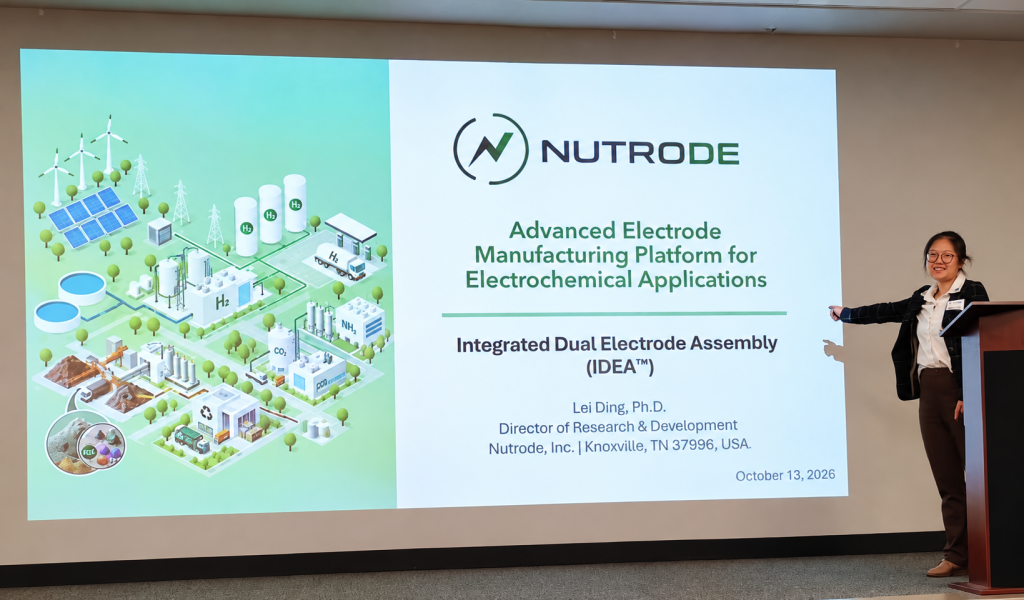
The use cases for Nutrode’s technology
Chemicals and fuels such as hydrogen, ammonia, and methanol are traditionally produced using fossil-based resources, often resulting in carbon dioxide emissions.
Ding said Power-to-X technologies use renewable electricity to produce these products through electrochemical conversion and, where needed, downstream synthesis, potentially reducing emissions.
According to a report from the International Renewable Energy Agency (IRENA), the global market for electrolyzers and associated equipment could reach $50–60 billion by 2050. However, Ding explained that high production costs remain a major barrier to market competitiveness.
Why? Electrodes are critical components of electrolyzers, and certain technologies rely on expensive precious metals, such as platinum and iridium, contributing to those higher costs.
How are they doing it differently?
Nutrode’s Integrated Dual Electrode Assembly (IDEA™) technology uses an innovative process to deposit precious-metal catalysts directly onto electrode substrates, reducing material consumption and simplifying manufacturing.
Ding explained that the process operates at room temperature and atmospheric pressure, eliminating several energy-intensive manufacturing steps.
“We have significantly simplified the process,” she said.
The technology can substantially shorten electrode fabrication time compared with conventional manufacturing methods. The company estimates that reduced precious-metal consumption and a simpler process could lower electrode manufacturing costs by more than 90%.
“Compared with conventional electrodes, our technology offers a simpler, more cost-effective, scalable, and sustainable manufacturing approach while maintaining high performance,” Ding said.
Backed by the University of Tennessee, Knoxville
Nutrode’s technology builds on innovative research discoveries and continued technology development at UTK, with the underlying research highlighted by the U.S. Department of Energy (DOE) Office of Science.
Ding worked on the technology during graduate school, earning her Ph.D. in 2024. She then completed a postdoctoral position at Argonne National Laboratory near Chicago before returning to Knoxville to join the company.
“I’m very familiar with all the technology because during my PhD, this is what I was working on,” she said.
Nutrode also recently received an award from UT’s Chancellor’s Innovation Fund and was selected for the 2026 cohort of the Spark Accelerator at UT Research Park. The company is also recognized by the UT Research Foundation and has been working closely with the organization to advance the commercialization of its patented technologies.
What’s next for Nutrode?
According to Ding, electrolysis for producing high-value products is Nutrode’s initial focus, but she sees broader potential for the technology.
She said the same manufacturing approach could also support energy storage, fuel cells, critical-material recovery, and converting waste into valuable products, she explained.
Ding said Nutrode has already demonstrated electrode fabrication at industrially relevant sizes of up to 70 cm². Building on this progress, she explained, the company is now focused on scaling up its technology toward industrial-scale manufacturing, with a target of 2028.
Connect with the Nutrode team.
Like what you've read?
Forward to a friend!