

Kunin develops chemical process to recover critical minerals from mine waste
The Chattanooga startup is developing a selective separation process designed to unlock overlooked minerals and reduce America’s reliance on foreign sources.
Mining companies know there’s more money on the table.
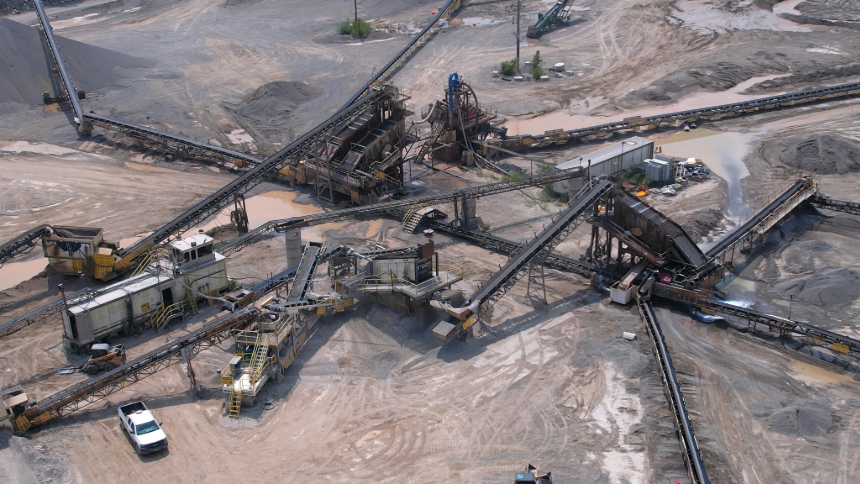
Every ore body contains 10 to 20 different metals, yet most mining operations are only designed to pull out one or two. The rest end up dissolved in a liquid waste stream. Think – alphabet soup, but for critical metals.
This inefficiency has national implications. Industries across the U.S. depend on minerals that domestic mines often overlook. The U.S. meets roughly 85 % of its antimony consumption through imports, according to the U.S. Geological Survey, and is almost fully dependent on imported gallium.
The U.S. Department of Defense has warned that shortfalls in tungsten, antimony, gallium, and germanium pose critical vulnerabilities for weapons production, according to S&P Global.
Kunin, a startup now based in Chattanooga, believes its chemistry process can help change that equation, bringing critical mineral mining capabilities back to the United States.
The company is developing a separation technology capable of selectively extracting valuable metals from complex solutions.
Founder and CEO Daniel Rau describes it as a platform that can recover “about half the periodic table of elements” by isolating metals that traditionally have been too expensive or too difficult to target.
How Kunin’s technology works
After careful geological study of an area, miners blast ore out of the ground using explosives. That ore is hauled and crushed into a powder. From there, the crushed ore goes through a series of chemical and physical processes designed to isolate specific metals, depending on the deposit.
“Our technology fits in with the selective extraction and separation, through a liquid separation and the selective removal of valuable metals like copper, gallium, germanium, vanadium, and scandium,” Rau said.
The idea addresses one of mining’s biggest inefficiencies. One deposit might contain copper as its primary target, but also hold smaller concentrations of high-value critical minerals. Kunin wants to help companies extract both the main product and the metals hiding in trace amounts.
He compares the challenge to “finding a needle in a haystack” or “being colorblind and trying to find a red ball in a ball pit.” The company is building on decades of chemistry research while adding its own proprietary spin.
To date, Kunin has raised $1.75 million to advance the technology. With the early funding in place, the next major challenge for Kunin became scaling production & piloting their technology at partners’ operations.
Why the company landed in Chattanooga
Kunin relocated to Chattanooga to partner with a manufacturer that specializes in polymer ion exchange materials, a critical component of the company’s technology.
“The move to Chattanooga was strategic on the manufacturing side,” Rau said. “Our manufacturing partner told me to bring the company here. He is someone we are going to be working with intimately to scale.”
Then, shortly after arrival, the founders of Brickyard, Matt Patterson and Cam Doody, took a special interest in Kunin’s technology. The critical materials mining startup became a portfolio company in Brickyard’s second fund.
How Rau’s path led to mining
Long before Rau launched a company, he was a chemical engineering student at Vanderbilt studying clean energy. But his interest in mining began with a hard look at the economics of the energy transition.
“There is this idea about net-zero and the green energy economy,” Rau said. “When I dug into the economics, I was horrified by the reality that these technologies simply did not make sense. To me, to be successful, they must produce economic value and must make something lower cost for consumers and industry.”
Seeking perspective, he took an internship in oil and gas. He reviewed investments, sourced technical information, and evaluated decarbonization technologies. But what struck a chord with him was a project looking into whether lithium extraction was viable.
That was his first real exposure to mining, and it changed his entire career trajectory.
“Through that process, I started to fall in love with the mining industry,” he said. “The economics are in your face. We need more metals. They are critical to everything.”
During his final two years of college, Rau focused entirely on mining. A Vanderbilt professor who invented a lithium extraction technology pulled him into graduate-level coursework and eventually encouraged him to help start a company. Rau became engrossed in lithium market dynamics and the technical details of extraction.
His early work earned a spot in the National Science Foundation’s I-Corps program, where he spent months talking to “hundreds” of people across the industry. The team secured a $50,000 grant and caught the attention of SQM, the world’s largest lithium producer.
It seemed like the momentum would never stop. Until it did. Another company had already patented a similar process. Rau said it was devastating.
“There was no path forward from an IP perspective,” he said. “I was dejected. I sat in the think tank for 30 to 45 days talking with my professor and mentors. What should we do?”
But that period of reflection brought him back to the hydrogen membrane research he completed at Vanderbilt. The idea evolved into what eventually became Kunin.
Within about six months, Rau secured about $1 million in pre-seed funding to launch the company.
What comes next?
Kunin is still early, but its ambitions are large. If Rau’s proprietary processes succeed, mining companies could begin recovering materials they have historically overlooked. It could expand domestic supply chains, increase revenue for operators, and reduce waste in the industry.
As Kunin grows in Chattanooga, Rau hopes the company can play a role in reshoring critical mineral processing and strengthening U.S. supply chains.
“I’m passionate about being able to mine every metal on the periodic table in America again,” he said.
You can connect with Daniel Rau here.
Discover more about Kunin here.
Like what you've read?
Forward to a friend!