


“Southeast Energy Policy Forum” wraps up its two-day run on Wednesday
It was a heavy hitter panel that jumpstarted the day with two CEOs of utility companies and the Chair of the World Energy Council.
The second and final day of the “Southeast Energy Policy Forum” kicked off with a panel of heavy hitters, moderated by Mike Howard, former Chief Executive Officer (CEO) of EPRI and Chair of the World Energy Council, and featuring the CEOs of Georgia Power and the Tennessee Valley Authority (TVA).
As Howard said at the start of the panel, “You’ll get a glimpse of the future.” The topic was titled “Utility Planning for Large Load Growth,” and featured Kim Greene, ironically a Knoxville native and graduate of the University of Tennessee, Knoxville, who is CEO of Georgia Power, and Don Moul, TVA’s new CEO.
Greene captured the challenge with a clear-cut example, noting that when Georgia Power last estimated its demand growth between 2023 and 2031, it projected it to be 400 megawatts. Recently, that figure has been updated to 6,000 megawatts.
As noted in an article in Tuesday’s edition of the Atlanta Journal-Constitution, that will require an additional $15 billion investment on top of an existing $35 billion over the next five to seven years.
She outlined three conditions that Georgia Power requires:
- Longterm contracts of 15 to 20 years;
- Minimum monthly bills; and
- Large termination fees for early cancellations.
Moul said TVA has a similar generating capacity – 6,200 megawatts – either under construction or being planned. That is designed to meet demands, including on the economic development front. He noted that 10 megawatts was the norm for years in terms of a big economic development project. Today, it is 100 megawatts.
On the small modular reactor at the Clinch River site, Moul said that the Nuclear Regulatory Commission is expected to act on TVA’s application by the end of 2026.
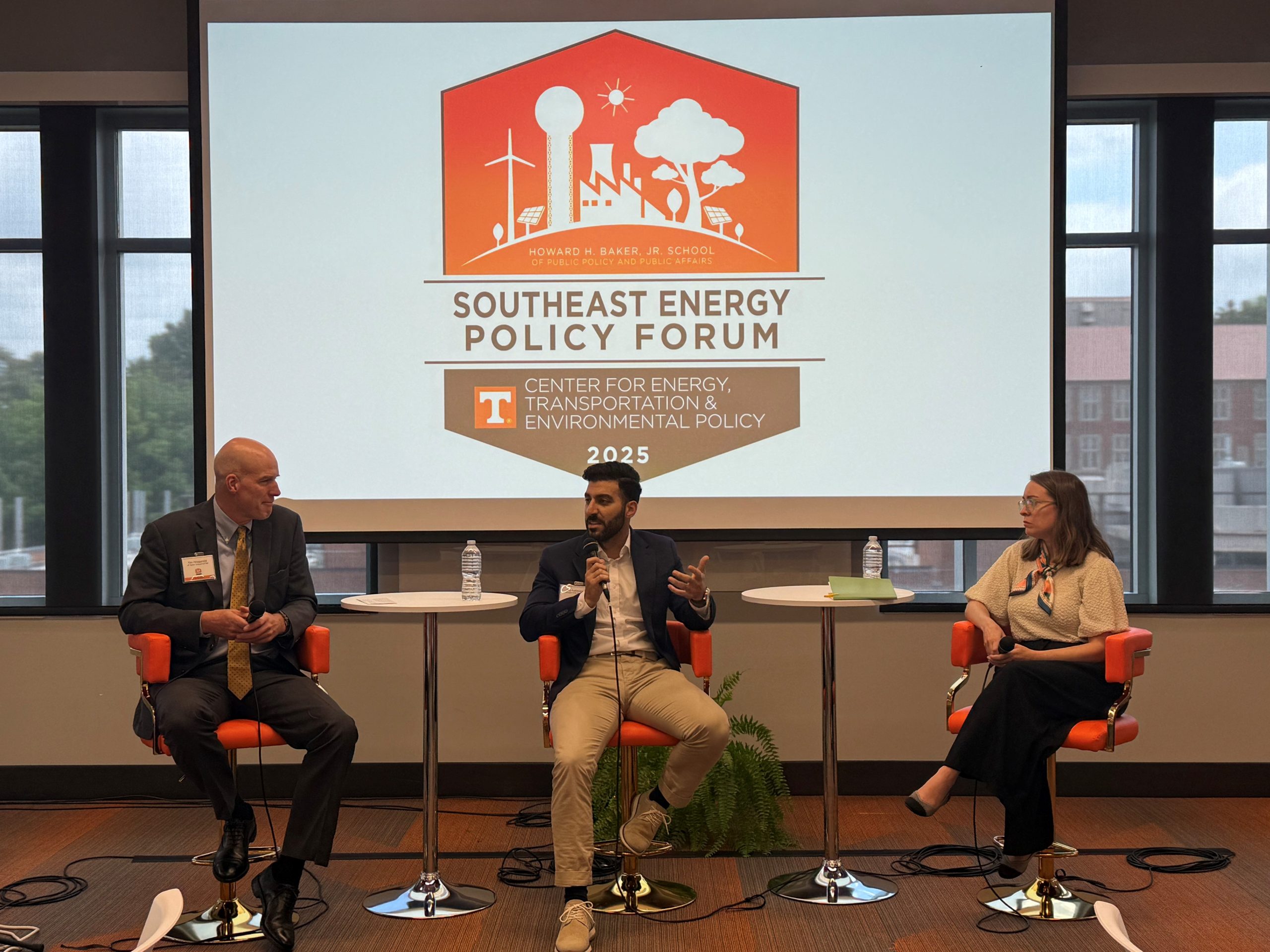 With artificial intelligence (AI) and data centers driving much of the demand for electricity, the forum had two representatives of two of the biggest hyper scalers represented. They were Ray Fakhoury, Energy Policy Manager for Amazon Web Services, and Katie Ottenweller, Southeast Lead for Energy Policy and Markets at Google.
Noting that Google has never closed a data center, Ottenweller told attendees how her 70-year-old farmer father is using AI to drive his business. She said that Google had used AI to help the City of Memphis find and patch 3,000 potholes.
Google has a goal of having carbon-free energy be available 24/7 by 2030, and she noted that one of the company’s partners in that journey is Kairos Power.
Ottenweller also said that data center demand, currently at 3.5 percent of electricity usage, is expected to double in the next few years.
Using a baseball analogy, Fakhoury said we are in the third inning of the baseball game, explains that 80 percent of data still resides on servers rather than in the cloud.
”We have spent too much time talking about the problem and too little time focusing on solutions,” he said. “How about we focus on figuring it out.”
Like what you've read?
Forward to a friend!