


How are Chattanooga’s quantum initiatives advancing talent and workforce?
On Thursday, partner organizations in Chattanooga's quantum ecosystem gathered for a lineup of presentations on how to move quantum from a research concept to real-world applications.
Quantum can be intimidating. Even seasoned technologists acknowledge that explaining the field to non-scientists can be a challenge. That is why Chattanooga’s growing quantum ecosystem is sharpening its focus on how this technology translates into real business applications and long-term economic development.
To that end, a unified group of regional partners is launching new efforts to make quantum more accessible. The Company Lab (CO.LAB), UTC’s Gary W. Rollins College of Business, the Max Fuller Center for Innovation and Entrepreneurship, UTC’s College of Engineering and Computer Science, the UTC Quantum Center, and EPB have joined forces to present the Quantum in Action series. Together, they plan to highlight quantum capabilities and emerging opportunities across Tennessee.

The first session of the year opened on Thursday with a half-day event in Chattanooga.
Quantum as its own industry
Ryan Harring, Director of Partnerships at IonQ, underscored that quantum is not a far-off concept. It is already an industry. Harring noted that IonQ, a company building quantum computers, has nearly a hundred open roles for technical quantum talent. A quick look at LinkedIn shows thousands of quantum-related jobs across the United States. The demand is here and accelerating.

To help prepare a future workforce, the National Institute of Standards and Technology awarded EPB a $4 million federal investment to launch a Quantum Computing Fellowship for eight students. The program will offer hands-on experience to innovators focused on developing quantum solutions that benefit EPB customers.
Universities across the state are also preparing students for quantum-driven careers. At the start of Thursday’s Quantum Activation Summit, four institutions described how they are integrating quantum into their academic and research programs. Middle Tennessee State University opened its Quantum Research Interdisciplinary Science and Education (Q-RISE) Center in 2025. Vanderbilt and EPB announced a new Institute for Quantum Innovation later that year. The University of Tennessee at Chattanooga established the UTC Quantum Center as a national leader in Quantum Information Science and Engineering. Tennessee Tech is expanding its Cybersecurity Education, Research, and Outreach Center (CEROC) to explore quantum-related applications.
The goal is to ensure students can step into roles at innovative companies like EPB and IonQ or apply quantum knowledge within whichever industry they ultimately choose.
Quantum integrating into other industries
Preparing talent is only one part of the strategy. The other is helping industries understand how quantum will affect their operations.
Jermaine Freeman, Executive Director of Economic and Workforce Development at UTC, said building strong relationships with private industry is essential. He emphasized that the future will not be about quantum in isolation but about quantum integrated with other fields.

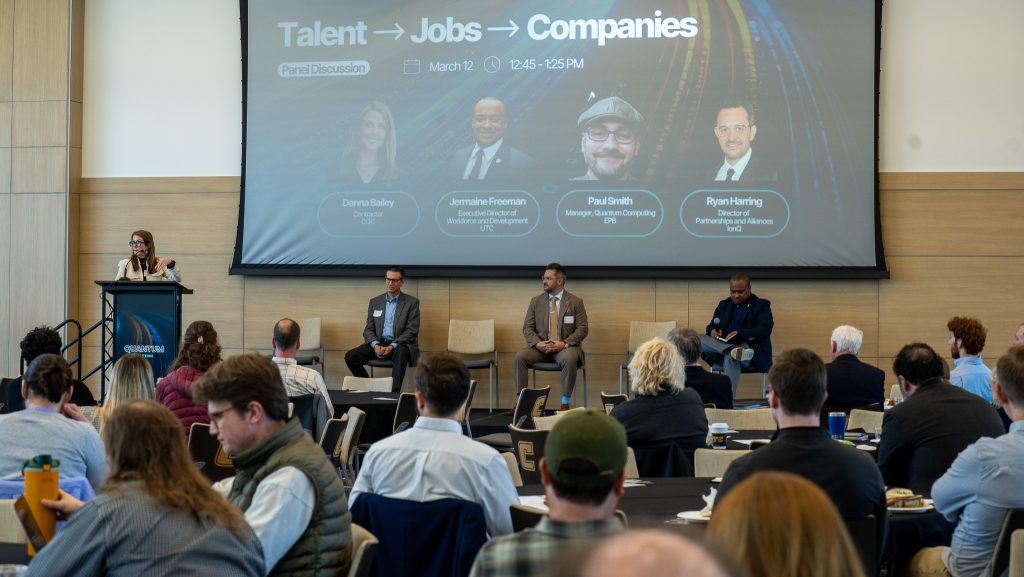
“It is going to be about quantum plus something else. For example, quantum plus engineering or quantum plus logistics,” Freeman said. “To do that, we need to improve our communication about quantum and its capabilities. We need to bridge the gap for folks who are non-scientists.”
Several sectors topped the list of likely early adopters. Logistics, pharmaceuticals, financial services, artificial intelligence, security, and cybersecurity all stand to benefit from quantum-enabled innovation.
And many in the room agreed that Chattanooga is well-positioned to lead that work. With a strong utility partner in EPB, active university collaboration, and a growing entrepreneurial ecosystem, the city has fertile ground for building and testing quantum technologies that support multiple industries.
Like what you've read?
Forward to a friend!