
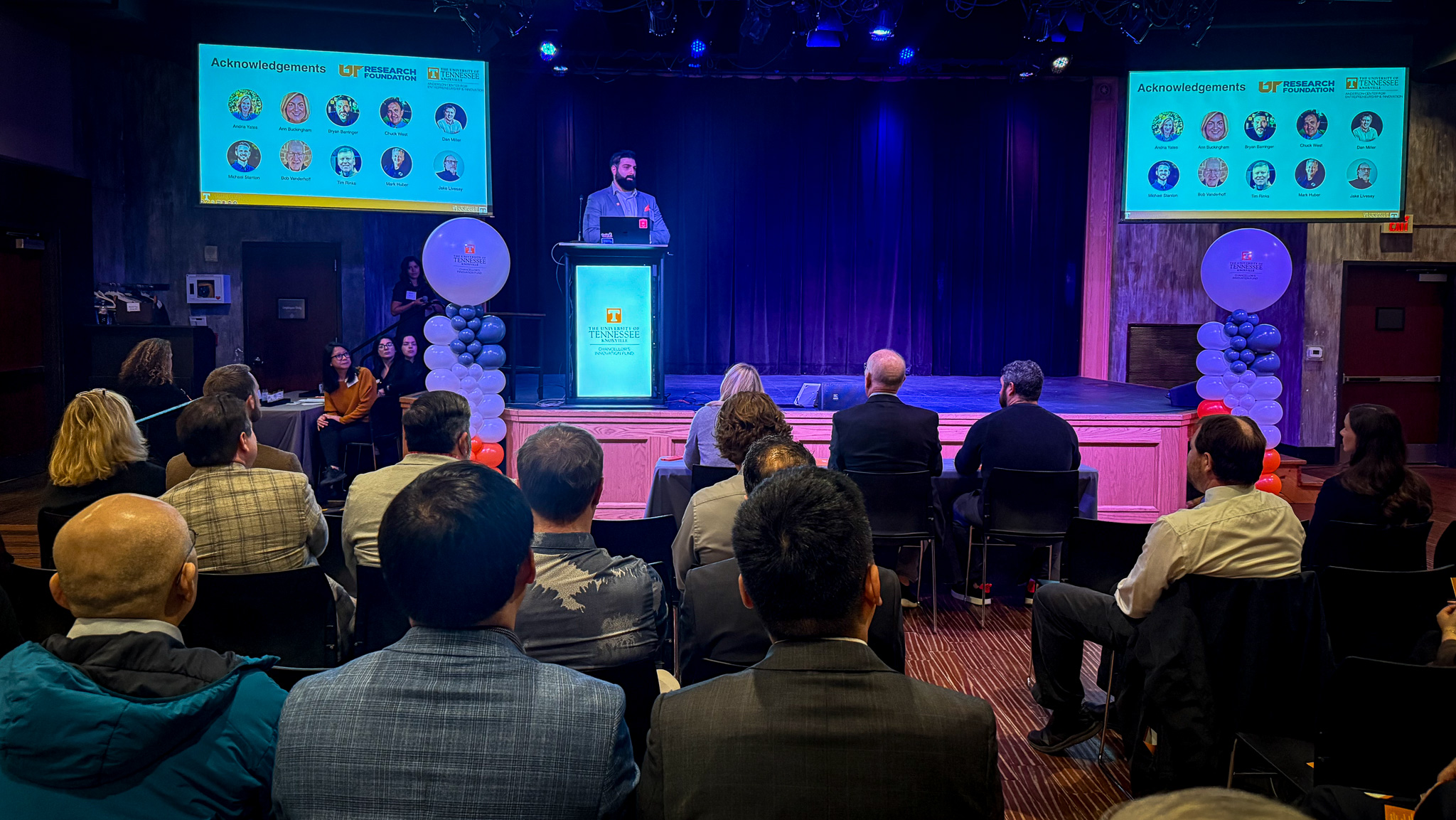
Eight UT innovators take the stage for Chancellor’s Innovation Fund, chance to secure $50K
The Office of Entrepreneurship and New Ventures within the Office of Research, Innovation, and Economic Development and the UT Research Foundation selected the semi-finalists to compete for five funding awards, each worth up to $50,000.
From self-replicating RNA to logistics solutions for last-mile deliveries, researchers and faculty at the University of Tennessee (UT) made the push from the lab to the stage to secure $50,000 in non-dilutive funding.
In its third year, the Chancellor’s Innovation Fund annually awards $250,000 to five UT System innovators. The awarded research can be anything from complex chemistry, agtech, and early-stage medical devices to commercially available products and SaaS solutions.
However, the most complicated part for the participants is translating what could be a decade’s worth of research into a five-minute, easy-to-understand presentation. The goal for presenters is to communicate product market-fit, customer-profiles, and commercialization plans for their technology or scientific discovery.
And, sometimes, the problems identified are so niche, so specific, and so much of a bottleneck that it takes a very skilled, dedicated, and passionate individual to solve them.
Self-replicating RNA for crops
That is certainly true of people like Scott Christopher Lenaghan, who is the Co-Director for the Center for Agricultural Synthetic Biology (CASB) and an Associate Professor for the Department of Food Science. One of his motivating factors for developing something called “self-replicating RNA” is the global issue of food insecurity caused by pests (like corn earworm) that ruin tens of millions of dollars’ worth of crops each year.
- Genetically modified organisms (GMOs, which have become controversial).
- Chemical agents and pesticides (which have become controversial).
- A process called double-stranded RNA, which acts as a molecular defense signal in plants, can destroy harmful pathogens like viruses, fungi, and pests.
But Lenaghan has something more enticing in mind, something he believes will save millions of dollars for crop farmers each year: self-replicating RNA.
Lenaghan described this special type of RNA operates like a vaccine for plants. It only needs to be applied once per year, which keeps the maintenance level and cost low.
“I want to get some money back into the hands of our nation’s farmers,” he said.
Lenaghan said the Chancellor’s Innovation Fund grant would help propel his research forward by being able to build out a demo and test on corn crops.
Constructing walls with less material
Another example of an innovative approach came from Maged Guerguis, an Associate Professor at UT’s College of Architecture and Design, and a McCarty Holsaple McCarty Endowed Professor.
His research at UTK revealed a process through which material could be uniquely designed for high-stress areas in a structure. Guerguis said this design is based on “biomimetic principles found in nature,” which maximize structural performance, minimize weight, and drastically reduce waste.
He later joined the Spark Innovation Center for its accelerator cohort in the fall of 2026 and officially launched a startup called OTTO Prefab. Guerguis applied to the Chancellor’s Innovation Fund in hopes of securing $50,000, which would allow him to build out a full-scale prototype.
“We want to create a full neighborhood of these homes by 2030,” he said. “It’s something I’ve been dreaming about for 20 years.”
His goal with OTTO Prefab and the new interior wall design is to deliver a net-zero emissions home with a predictable cost and construction schedule.
The competition
The judges for the Chancellor’s Innovation Fund competition were tasked with selecting five out of the eight presenters to be the recipients of the $250,000. Each one of the five will recieve $50,000.
The judging panel included Anna Douglas, the founder of SkyNano; Don DeRosa, the founder of Eonix; and John Bruck, the co-founder of 121 Tech Hub, Market Square Ventures, and a well-known area angel investor, strategist, and startup supporter.
The presenters included:
- Scott Christopher Lenaghan: Development of self-replicating RNA for spray-on RNAi pesticides
- Cong Trinh: Biomanufacturing of natural butyl acetate
- Feng Yuan Zhang and Weitian Wang: Commercializing effective and integrated electrodes for low-cost electrolyzers and energy storage
- Madhu S. Dhar and Steven Newby: Novel universal bio-inks for tissue engineering and regenerative medicine
- Maged Samir Guerguis, OTTO Prefab: Commercial readiness validation of the U-panel system for net zero smart homes
- Yang Zhao: Vision-based systems and methods for automated individual tracking of poultry in pen settings
- Marcella Kaplan: User interface for the parallel scheduling vehicle routing optimization platform
- Xueping Li and Madelaine Martinez-Ferguson: A cognitive digital twin for intermodal transportation planning
Learn more about the Chancellor’s Innovation Fund 2025 winners.
Like what you've read?
Forward to a friend!