


Cybersecurity for Startups: Five Risks You Can’t Ignore
Cybersecurity is a critical priority for startups because they can be prime targets for cyberattacks, face severe financial and survival risks, and require verified security compliance to win clients and funding.

One overlooked vulnerability is all it takes to undo months of hard-won progress, and for a startup, the fallout can be existential.
Cybersecurity isn’t a back-office afterthought; it’s a frontline safeguard, and startups can meaningfully strengthen their security posture by understanding the risks they face, taking proactive steps to address them, and keeping pace with emerging trends.
Below, we outline five key cybersecurity risks every startup should keep on its radar:
1. Social Engineering and Ransomware
Let’s be honest: your business’s data is valuable, and that makes it a target. Cybercriminals know this too, and their tactics for obtaining it are increasingly difficult to detect.
What is social engineering?
Think of social engineering as digital con artistry. A scammer might call pretending to be tech support (vishing), send an email that looks like it’s from your bank (phishing), or text a link disguised as a delivery notice (smishing). The tactics vary, but the goal is always the same: trick you into handing over the keys to your data.
Once a scammer talks their way into your systems, they can lock you out of your own technology and demand a hefty payment before handing back the keys (if at all).
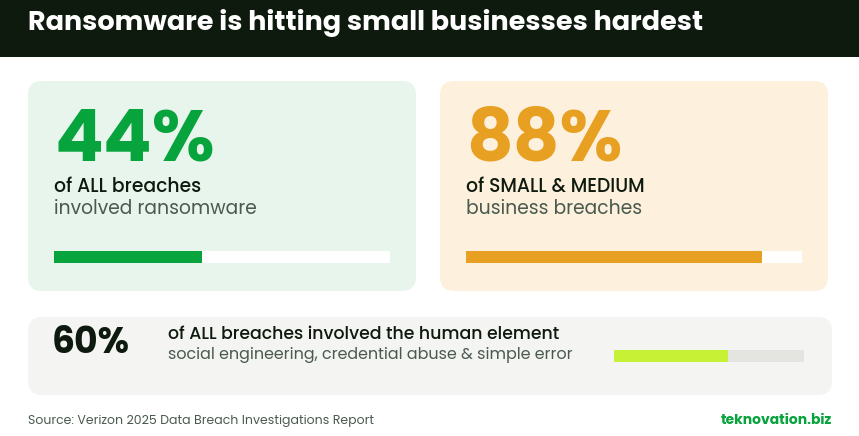
Verizon’s 2025 Data Breach Investigations Report found that ransomware was present in 44% of breaches overall, and in a striking 88% of breaches affecting small and medium-sized businesses specifically. Human involvement factored into roughly 60% of all breaches, including social engineering and credential abuse.
So what’s your best defense? Stay a little skeptical. Think twice before clicking a link from someone you don’t recognize, double-check any unexpected request for sensitive information, and when in doubt, verify it through a separate, trusted channel before you act.
2. Cloud Misconfiguration
Startups rely on cloud tools for good reason. They are flexible, scalable, and often more cost-effective than building everything in-house. Providers like Microsoft, Google, and Amazon invest heavily in security, but that does not mean your business can put cloud security on autopilot.
Your cloud provider secures the platform, but you still must secure how your business uses it. Misconfigurations rarely happen on purpose. They creep in when default settings are never revisited, when a new tool is introduced quickly to meet a deadline, or when file permissions are set once and forgotten. Left unchecked, small oversights like these can quietly expose sensitive data to anyone with a link.
Businesses should regularly review these areas:
- File sharing settings for tools like OneDrive, Google Drive, Dropbox, Teams, and SharePoint
- Storage settings that could accidentally make sensitive files public
- Logging and alerting for unusual sign-ins, permission changes, and suspicious activity
Set a recurring quarterly cadence to revisit these settings as your team and toolset grow. Cloud environments change quickly, and a secure configuration can drift out of alignment as new users, integrations, and features get added.
3. Supply Chain and Third-Party Vulnerabilities
Cloud providers are just one example of an outside party that can introduce risk into your business.
Startups often depend on vendors, contractors, software providers, payment processors, and other third parties to move quickly and operate efficiently. That’s normal, but it also means your security posture may depend in part on how those outside parties protect your data, systems, and customers.
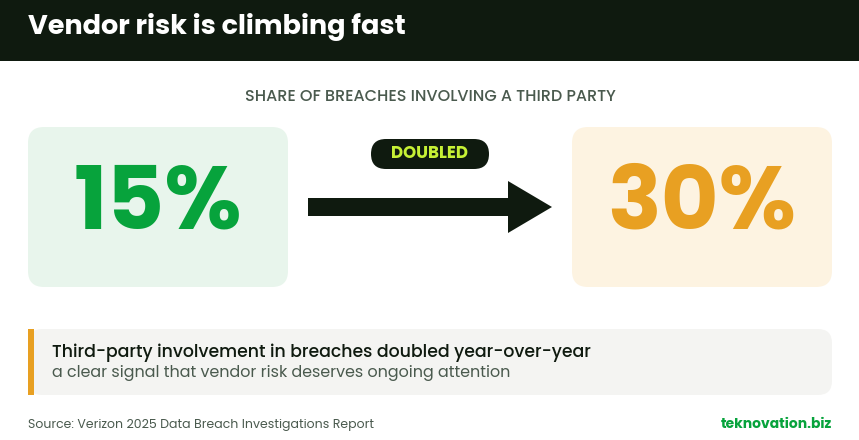
Verizon’s 2025 Data Breach Investigations Report found that third-party involvement in breaches doubled year-over-year, from 15% to 30%, a clear signal that vendor risk deserves ongoing attention.
Focus your effort where the risk is greatest.
Not every vendor needs the same level of review.
For example, you may want to review the pricing and key terms in a contract for cleaning services. Still, your deeper security review should usually be reserved for vendors that store sensitive data, access your systems, support critical operations, or interact directly with customers.
Before signing, ask practical questions: What data will this vendor access? How will they protect it? What happens if they experience a breach? Once the relationship begins, keep checking in periodically so vendor risk does not become a one-time exercise.
The importance of a SOC 2 Type 2 audit
It’s also worth asking whether key vendors undergo an annual SOC 2 Type 2 audit. These audits, performed by independent CPA firms, assess the security controls a vendor has in place to protect customer data. Reviewing the resulting report gives you real insight into those safeguards and flags any control-related concerns that may directly impact your environment.
Curious how to review one? Check out this PYA insight: How to Review a SOC Report for Third-Party Risk Management.\
4. Weak Access Controls and Credential Management
Think about how many passwords you juggle every day. If you’re like most people, you’ve reused one at some point, or made it just complex enough to remember.
Cybercriminals count on this.
Once they get their hands on a leaked password from one site, they’ll try it everywhere else, a tactic known as credential stuffing. A single weak or recycled password can be all it takes to open the door to your entire business.
The fix starts with the basics: require multi-factor authentication everywhere it’s available, and use a password manager so that unique, complex passwords stop being a burden to remember.
The National Institute of Standards and Technology’s (NIST) latest Digital Identity Guidelines (SP 800-63, Revision 4) favors long passphrases and breach-list screening over forced complexity rules and periodic password changes, unless there’s evidence of compromise. Give employees access only to what their role requires and review permissions periodically to remove any that are no longer needed. Just as important: build formal offboarding into your standard processes so that access is revoked the moment someone leaves the company, not weeks later.
5. Data Loss and Business Continuity Disruption
We’ve all had a document crash before we hit save, or lost photos on our phone because they weren’t backed up to the cloud.
Now imagine that same scenario, but amplified across your entire business: a ransomware attack encrypts your files, a hard drive fails, or an employee accidentally deletes critical data. Without a reliable way to recover, that single event can halt operations, erase customer records, and put your business’s survival at risk.
The best defense against this risk is a dependable backup and recovery strategy. Establish a regular backup schedule, confirm backups complete successfully and monitor for failed attempts, and periodically test your ability to restore.
The Cybersecurity and Infrastructure Security Agency (CISA) recommends following the 3-2-1 Rule: keep at least three copies of your data, store two backup copies on different media types, and keep one copy offsite. Document your testing and retain that evidence, so you have a clear record to support your recovery capabilities if you’re ever audited.
Closing Considerations
This is by no means an exhaustive list of the cybersecurity risks that startups encounter, and no single fix will address all of them. What matters most is building a structured, ongoing approach rather than reacting one issue at a time.
A good starting point is a recognized framework, such as NIST’s Cybersecurity Framework (CSF), which offers flexible, industry-agnostic best practices you can tailor to your circumstances as your security program matures.
Once that foundation is in place, a SOC 2 Type 2 audit can help validate it, giving customers, partners, and investors independent proof that your safeguards actually hold up. This is especially useful once you start fielding a steady stream of security questions from the people you do business with.
Choose your audit partner carefully: when it comes to proving you protect data, quality matters more than the price.
The risks outlined above share a common thread: each one hides behind an assumption that everything is fine, until it’s tested. Startups that examine those assumptions now, rather than after an incident, are best positioned to prevent a single overlooked vulnerability from becoming an existential and expensive one.
Learn more about how PYA can help you manage cybersecurity risks.
Like what you've read?
Forward to a friend!