


DOE Chief of Staff predicts more money will flow into Oak Ridge nuclear
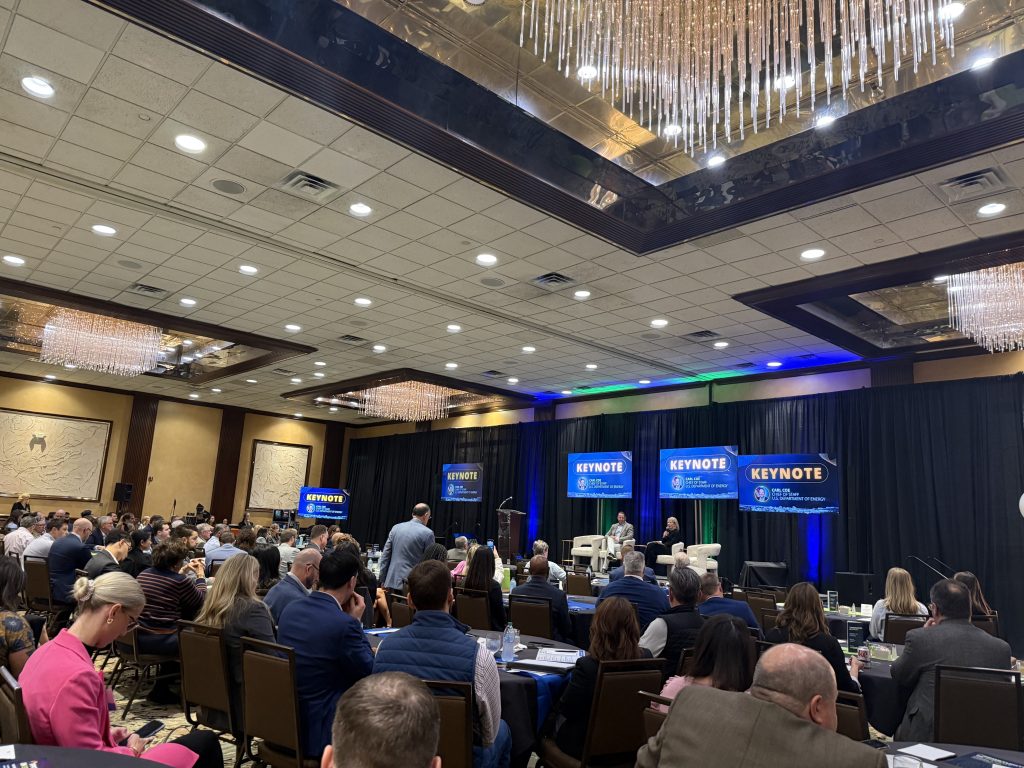
U.S. Department of Energy (DOE) Chief of Staff, Carl Coe was the keynote speaker for a packed house at the Tennessee Advanced Energy Business Council Opportunities in Energy event.
All eyes in the room locked on U.S. Department of Energy (DOE) Chief of Staff Carl Coe as he took the stage for a candid conversation about the state of energy across the United States, and how East Tennessee (particularly Oak Ridge) fits into the puzzle. The lively discussion was moderated by Dr. Marianne Wanamaker, the Dean of the Baker School for Public Policy at the University of Tennessee, Knoxville (UTK).

The keynote presentation kicked off a full day of programming for the Tennessee Advanced Energy Business Council (TAEBC) Opportunities in Energy event, which had more than 300 people in attendance. The room was the picture-perfect capture of some of the most influential individuals in advanced energy across the state and country, including CEOs and presidents of new nuclear in Oak Ridge, executives in fusion, leaders at the national lab, leaders in national security, leaders in environmental cleanup, elected officials, and more.
Approximately 300 people registered to attend.
Background on Carl Coe
Coe joined the DOE to lead the Department of Government Efficiency (DOGE) efforts in 2025. He was named the Chief of Staff for the DOE in May, having assumed the role in May.
According to the DOE, he spent 17 years with PTC in various senior roles, including positions in London, Brazil, and the Americas. While at PTC, he worked extensively with the DOE and the National Labs, focused on product development and lifecycle management. According to his bio with the DOE, in 2018, Coe acquired Mango Practice Management and grew the company by 700 percent in about five years as the Chief Executive Officer.
Now, as the Chief of Staff to the Secretary of Energy, Chris Wright, Coe shared his perception of the energy landscape through the lens of both the public and private sectors.
Let’s dive into his thoughts, prompted by Dr. Wanamaker’s questions.
Do you think we need a national energy strategy that transcends administration?
Some believe the partisan nature of energy seems to be sunsetting, with both parties in alignment that energy is critical to long-term global success in artificial intelligence, national security, and quality of life.
“I feel like we are getting to a point where we will see less of a swing during administration changes,” Coe said. “We know that we need to double our energy capacity to meet the needs of AI and compete with China… Politics has to get out of the energy conversation. If we make it political, we lose.”
Is the rest of the nation in agreement?
“Politics are there. Utilities are there. Government is there. The private sector is there,” Coe said.
However, when it comes to the general public, Coe was not as optimistic about their outlook. Due to the history in Oak Ridge and its ties to the Manhattan Project, folks in the area are familiar with nuclear concepts. It’s part of the regional DNA. But, in other parts of the country, more education is needed, Coe suggested.
What is the Japan deal?
Unprompted, Coe loosely detailed a deal underway with the Trump administration that could bring $550 billion to the U.S. from the Japanese government.
Initially, the U.S. was planning to enforce a 25 percent tariff on imports from Japan, which would have crippled the international car market. After negotiations, the import tariff has been lowered to 15 percent, and, according to the White House, Japan has verbally committed to investing $550 billion in the United States economy.
During Wednesday’s Opportunities in Energy event, Coe shared with the audience that a chunk of those dollars could be allocated to energy infrastructure, nuclear, and other advanced energy initiatives.
NOTE: The exact dollar amount has not been publicly disclosed or reported, nor has the timeline. The White House has also not released a statement to confirm or deny these claims.
Dr. Wanamaker further questioned the $550 billion potential Japanese investment to ask whether those dollars would come to Tennessee.
“Nothing is defined…But it’s hard to imagine East Tennessee not playing a big role,” Coe said. “No other place in the country has this mix – A DOE national lab so closely aligned with the university…public acceptance of nuclear… low taxes. We can’t help but think of East Tennessee.”
Read more about the Japan Deal in this Bloomberg article.
What is the ‘Genesis Mission’?
Though there has been no public statement from the White House to confirm or deny the claim, Coe said there’s a new Executive Order (EO) coming out on Monday, November 24, about an objective called the ‘Genesis Mission.’
Coe revealed the general idea behind the initiative, which he said is to help get private businesses off the sidelines regarding R&D. The EO plans to bridge the gap between private partners with innovators.
“The goal is to create public-private partnerships that accelerate R&D,” he said, suggesting that the government would operate as more of a facilitator versus an implementer of these partnerships.
You can read more about the Genesis Mission in this Bloomberg article.
The TAEBC Opportunities in Energy event ran through the whole day, featuring speakers from a broad range of advanced energy businesses, as well as leaders from city, state, and federal partnerships.
Get connected with the TAEBC membership here.
Like what you've read?
Forward to a friend!