


PAN Biologics has a new approach to cancer treatment: Turn off the cancer trigger upstream
When a person finds out they have cancer, their whole world stops. Before they even wrap their mind around the diagnosis, patients are confronted with treatment options: chemotherapy, radiation, immunotherapy, targeted therapy, surgery, and every option in between.
Dr. Kuntal De has spent decades immersed in cancer research and treatment. He knows something needs to change and believes his discovery could be the missing ingredient in treatment.
De discovered a domain in oncogenic proteins that can be targeted to block cancer pathways.
How does it work?
Understanding how healthy cells become cancerous can get complicated fast. However, De explained it simply.
Hepatocyte growth factor (HGF) is a natural protein that latches onto a receptor on the cell surface. When it docks, it flips on signals that help cells grow, divide, and move. But when this interaction becomes overactive, cancer cells can exploit those signals to grow and spread.
That’s how people get tumors.
The piece of HGF that docks and flips the cancer “on” is a very small unit called the PAN domain, and that’s the exact trigger spot De is targeting.
His company, PAN Biologics, is developing a cancer therapy that is applied to the PAN domain to shut off cancer signaling. This would be a big shift for the cancer treatment industry, which typically fights tumors after they’ve already started growing.
“We validated that this method is stopping the cancer and it is not triggering tumor cell formation,” De said joyfully.
In his next phase of research, De is focused on figuring out how to couple this discovery with the use of targeted radioisotopes, so they can not only shut off the signal but kill cancer cells altogether.
The value of a strong technology transfer program
De worked at Oak Ridge National Laboratory (ORNL) from 2019-2024, when he first learned about the PAN protein domain from his former principal investigator (PI), who identified this domain’s role in immunomodulation using computational analysis. But just within the past couple of years, De and his team uncovered through wet-lab research that PAN could serve as the “on/off switch” for cancers, infectious diseases and agriculture.
“This technology’s birthplace is in Oak Ridge National Lab, and people need to know how instrumental they have been as a partner to us,” he said.
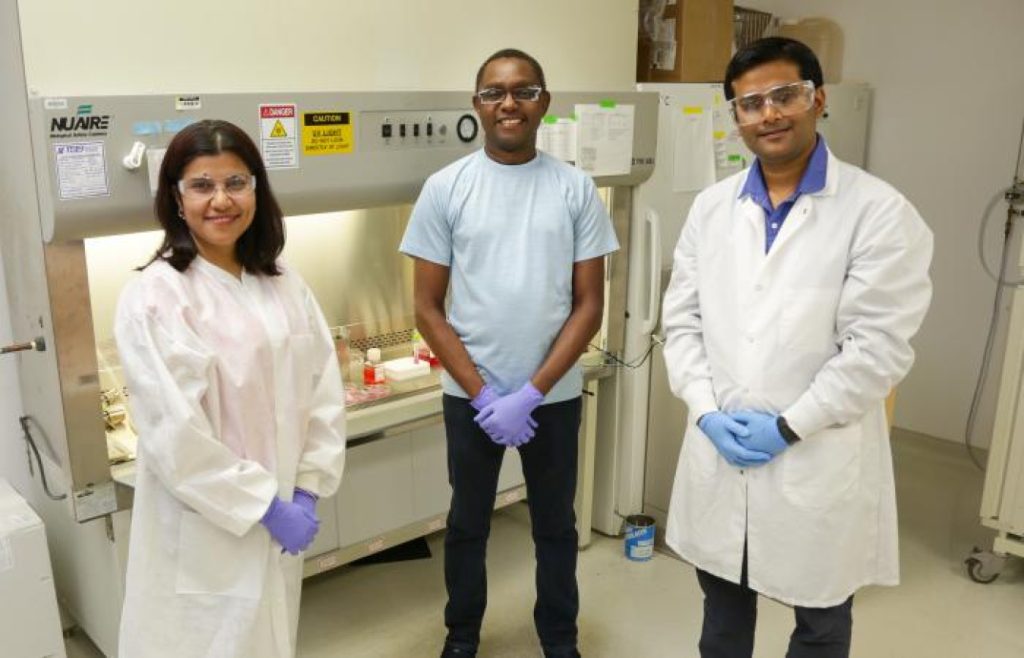
Awestruck by the potential of the discovery, and with the backing of the national lab, De began the technology transfer process of moving the technology into the marketplace.
“Oak Ridge’s technology transfer is immensely good,” he shared. “Since they filed the patents, I can continue developing this technology through our company under an exclusive license and help build our ecosystem”.
Unlocking a new domain
While cancer and infectious diseases are where De hopes to scale PAN Biologics’ applications, he noted several other industries would find undeniable benefits.
According to ORNL research, the PAN domain turns up in more than 28,000 proteins across hundreds of genera.
“As you could expect, there are many use cases. When I engineered this domain in crops, they were resistant to fungal diseases,” De said. “So, there’s been a lot of interest in that realm, as well.”
A ‘thank you’ to Knoxville-Oak Ridge
Though De isn’t originally from the area, he said he’s in East Tennessee to stay. Regarding his R&D efforts for his company, there is added value in his close proximity to the radioisotopes being produced at ORNL. But De said his desire to build his company from a Knoxville base runs much deeper.
“There’s a huge opportunity here – you can get radioisotopes from the source, the labs are equipped to do experiments and trials… I would argue there’s no better place than Knoxville-Oak Ridge to do what we’re doing” he said.
De is in the fall cohort of the Spark Accelerator at UT Research Park at Cherokee Farm. He extended his gratitude to the program for helping him approach commercialization with a business mindset.
“With all the resources, talent, and community, we love it here,” he added.
Discover more about PAN Biologics.
Like what you've read?
Forward to a friend!