


A heart attack led Jason Wold to build a device that counteracts
Life teaches the body to react negatively to stress. This device will retrain the body and regulate the nervous system.

Jason Wold has held a lot of titles: U.S. Navy air traffic controller, restaurant worker, musician, author, youth football coach. Founder and inventor are his newest titles, and they stemmed from the hardest year of his life.
“Last year, I went through a big turning point in my life,” he said. “I got fired, got divorced, and I had a heart attack.”
Doctors later discovered Wold had a congenital heart defect. He was coaching youth football on the hottest day of the year when he collapsed on the field and woke up in the hospital.
Finding purpose after a health scare
Wold’s heart attack, and the sequence of events that led up to it, acted as a literal wake-up call.
“I didn’t know what to do with my life. I needed to talk through this. I legitimately started using AI just to talk with it as a sounding board,” he said. “It talked me through what I really enjoy doing, and that’s coaching youth football. And at the bottom of that is my passion for helping people. I also learned just how cool AI is and what you can do with it. That reignited my love for research.”
With these new realizations, Wold began thinking about whether a device could have flagged his heart attack before it happened.
“Everyone has wearables these days. I might get multiple numbers from all of mine, from the Apple Watch to an Oura Ring,” he said. “But none of them are truly real-time, and none of them saw that I was going to have a heart attack.”
From a class project to a company
Wold was ready to go back to school and dig into this problem. He enrolled at Middle Tennessee State University (MTSU). What started as a research focus has since become his company, Vector Research Labs. The venture is only a few months old, but it is already in the prototype phase with a growing list of partners.

“I have one with MTSU already and I’m in talks with their VA Center. I’ve done the NSF Mid-South I-Corps program through Vanderbilt. The University of California, Irvine reached out about a project with its esports team, and Morehead State University has expressed interest in collaborating on computational imaging research,” he said. “And the big one is the NFL. If we can show that this works, they may take us to their leadership and then disperse us out to the teams individually.”
Wold is especially excited about what the NFL partnership could open up, since the league already works with strong device manufacturers. Rather than compete on hardware, he sees room to team up — licensing the underlying tech to an established manufacturer.
How the device works
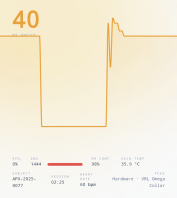
Wold’s device is essentially a “dog-collar style” that uses two small vibration tabs. The device is tracking one’s actual cognitive and physical readiness level through a number of data points supported with AI.
When levels are rising, the vibration tabs stimulate receptors in your carotid and reset your nervous system. If this “reset” doesn’t work, it’s clear that a bigger medical event could be on the horizon and to seek help right away.
He’s excited to share his first prototype soon!
Contact Wold via email here.
Like what you've read?
Forward to a friend!