


Meet HPC Intelligence, the AI-powered knowledge engine startup solving supercomputing’s talent gap
"There's not enough AI developers, and there's not enough HPC developers," Skjellum said. "We're taking the combination of AI and what we know in high performance computing and software engineering and putting that in an envelope to make programmers better."

Dr. Tony Skjellum has spent decades at the frontier of high-performance computing (HPC). He’s a professor of computer science and director of Tennessee Tech’s ASCEND Center. In these roles, he has gotten a front row seat to the industry’s challenges.
HPC engineers take three to five years to train. Once on the job, they earn great money at frontier AI labs, but there simply aren’t enough of them.
There needs to be something that makes these rare engineers who program supercomputers dramatically more productive to fill the talent gap and the rate at which computing is progressing, which outpaces supply by 4:1.
Enter HPC Intelligence. The startup pitched recently at AI Tennessee‘s “From Lab to Market” event.
Why are everyday LLMs not an answer?
The gut reaction to this problem would be to point developers toward general-purpose AI coding assistants. But Skjellum was clear to point out that this path does not hold up under scrutiny. Tools like GitHub, Copilot or publicly available Large Language Models (LLMs) carry intellectual property risks and produce code of inconsistent quality.
“If everyone uses the same AI, every piece of software will have the same vulnerabilities,” Skjellum said. “Hackers can exploit that.”
Plus, this route can be plain-out inefficient. For example, when junior developers submit AI-generated code to senior colleagues without fully understanding it, it can result in more work for the engineers who have to review and fix it.
That’s why HPC Intelligence stays behind the firewall
Rather than routing proprietary code through a public model, HPC Intelligence runs entirely within a customer’s own infrastructure to avoid these liabilities.
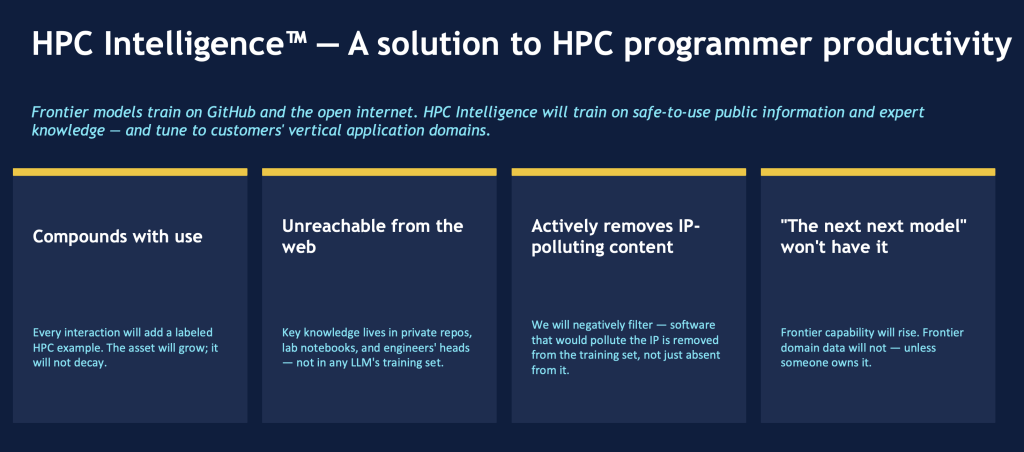
Skjellum described the platform as “an angel on your shoulder rather than a demon” that observes a developer’s recurring mistakes, understands the codebase’s context and offers targeted guidance without replacing human judgment.
A key design principle, he said, is separating the AI that writes code from the AI that tests it. It’s a native checks and balances system.
The path to commercialization
HPC Intelligence remains in an early incubation phase within Tennessee Tech. He’s eyeing the Department of Energy (DOE) Genesis Mission and the National Science Foundation’s new Technology, Innovation and Partnerships (TIP) initiative as funding sources when the time comes.
“We’re looking at a two-phase approach,” he said. “Applied research, then beginning to create minimum viable products.”
Once those products are live, the target market includes Fortune 500 companies with active supercomputing development operations and DOE national laboratories, which Skjellum said cannot get enough qualified HPC engineers.
He’s confident of the plan, which makes sense as Skjellum is no stranger to the startup path. He and his wife, Jennifer Skjellum, now with LaunchTN, previously co-founded a company that was acquired by a venture-backed firm in San Diego.
It’s HPC time in Tennessee
Skjellum understands that right now is a very promising time for such a startup, especially in Tennessee, and he plans to take advantage of that.
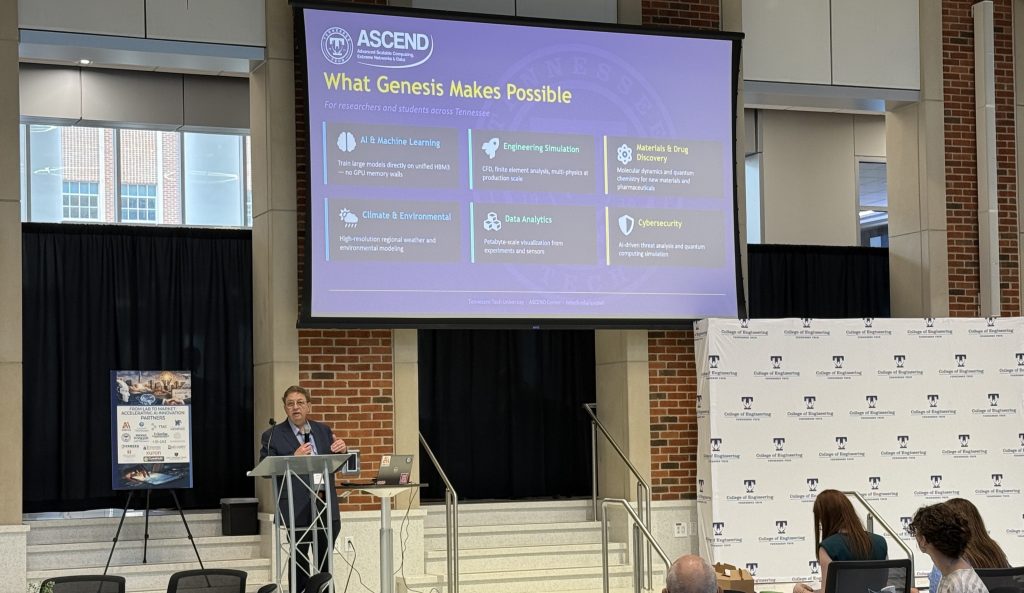
The ASCEND Center just brought online its own supercomputer named GENESIS. Oak Ridge National Laboratory (ORNL) houses some of the most powerful publicly known supercomputers in the world. Oracle recently relocated its headquarters to Nashville. AWS has placed thousands of jobs in the region. And East Tennessee has emerged as a center for advanced nuclear development, an industry that runs heavily on high-performance simulation.
There’s clear momentum, and he’s ready to connect via email.
Like what you've read?
Forward to a friend!