

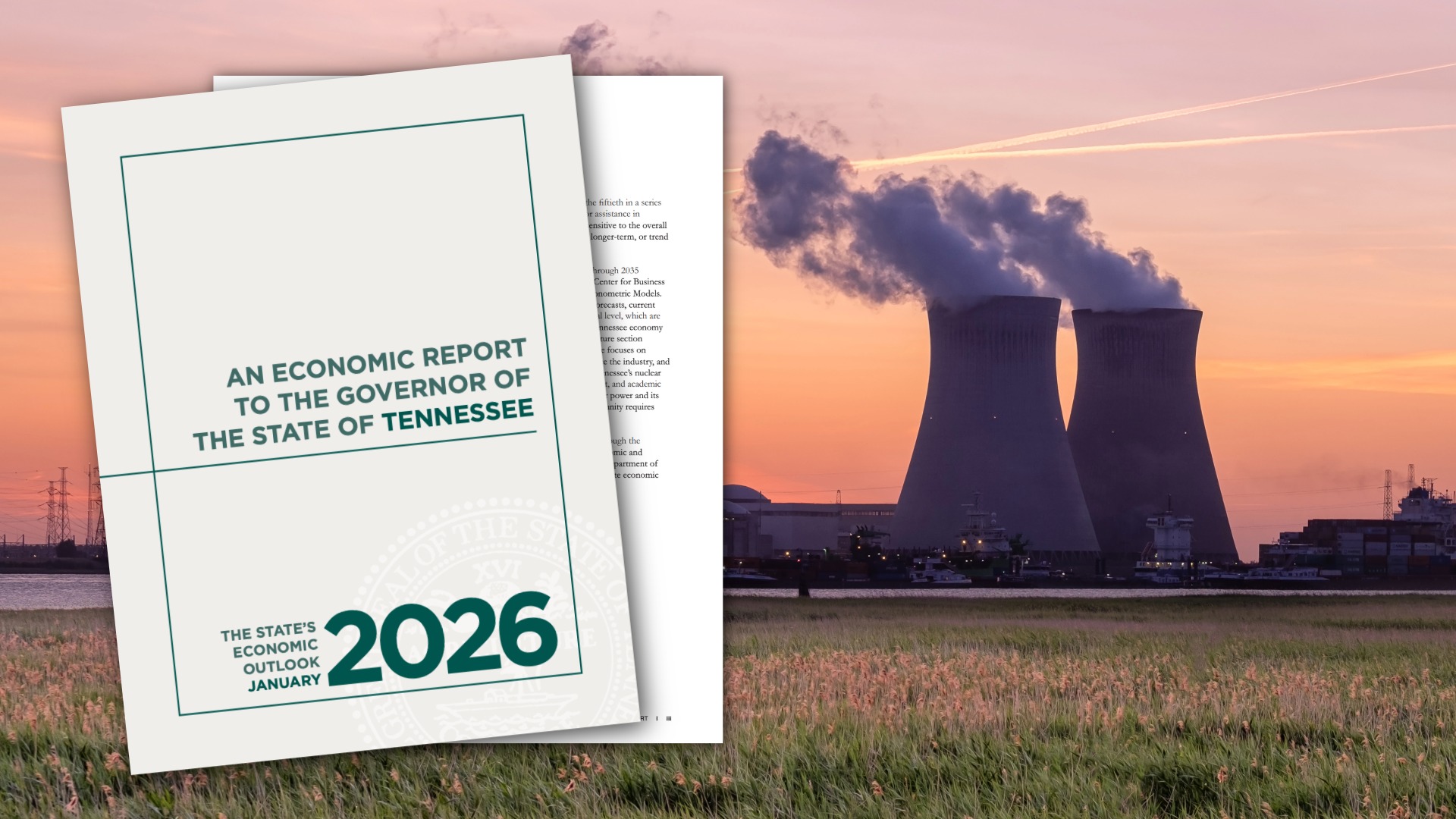
Nuclear economy is a key focal point in the annual Boyd Center Economic Report
Each year, the Boyd Center for Business and Economic Research at UT, Knoxville provides an economic report to the Governor of Tennessee.
Tennessee was comparatively resilient amidst federal economic uncertainty in 2025, at least that’s what the Annual Economic Report from theBoyd Center for Business and Economic Research at UT, Knoxville, showed. While trade policies rocked the boat, Tennessee’s real GDP still grew 1.7 percent this year. However, compared to strong growth years, like 2.7 percent in 2024 and 3.2 percent in 2023, it shows that Tennessee was not completely immune to the national trends.
Expectations are for Tennessee’s real GDP to grow by a slightly faster rate of 2.0 percent in 2026.
The report was split into three chapters: U.S. Economy, Tennessee Economy, and the Role of Nuclear Energy in Tennessee’s Future.
Comparatively, last year’s report (2025) focused heavily on the economic implications of artificial intelligence; in 2024, it focused on business formation efforts; and in 2023, it focused on advanced manufacturing. The report paints a picture of the top area of growth in the state.
“The state of Tennessee is uniquely positioned to help lead the United States on a path towards a nuclear energy renaissance, leveraging its historical expertise, robust infrastructure, and forward-thinking policies,” the report stated.
The report also shared some key challenges for Tennessee to realize its full potential in this sector:
- Managing high initial costs and lengthy construction timelines.
- Ensuring workforce readiness through education and training programs.
- Modernizing infrastructure to support advanced reactor technologies
- Navigating regulatory complexities
According to the Boyd Center report, Tennessee’s nuclear industry has a strong foundation. The state generates over 40 percent of its electricity from nuclear power—far exceeding the national average—and is home to hundreds of nuclear-related companies. The University of Tennessee, Knoxville (UTK), boasts the largest nuclear PhD program in the nation, ensuring a steady pipeline of talent, and ORNL continues to be a global leader in advanced reactor research.
These factors collectively position Tennessee as a critical hub for nuclear innovation. However, the future of the nuclear industry in Tennessee and the broader U.S. will be influenced by whether advanced technologies like small modular reactors (SMRs) can be successfully deployed. While SMRs promise scalability, lower costs, and reduced construction times, the technology remains unproven at commercial scale.
A local example: the Clinch River SMR project could serve as a test for their commercial viability.
Under the most optimistic TVA 2050 forecast for incremental nuclear capacity, Tennessee stands to benefit significantly from SMR construction and operation. The economic benefits would include significant job creation, increased tax revenues, and growth in ancillary industries.
Like what you've read?
Forward to a friend!