

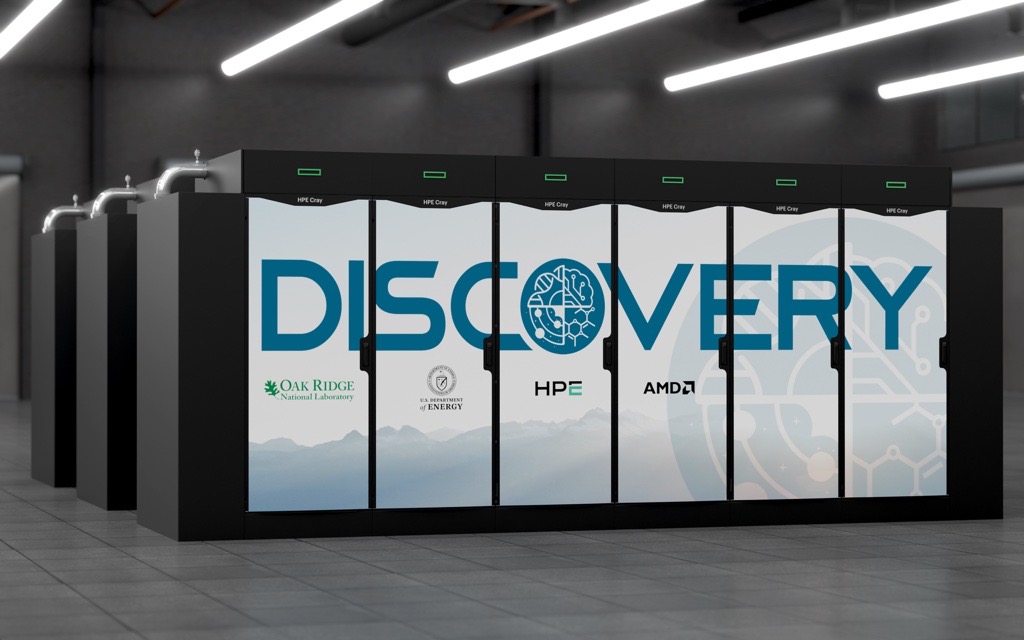
ORNL will soon add two new supercomputers to its lineup
The U.S. Department of Energy announced on Monday its newest supercomputers, Discovery and Lux, at Oak Ridge National Laboratory (ORNL).
In a continued effort to win the race for artificial intelligence capabilities, the Department of Energy (DOE), alongside Oak Ridge National Laboratory (ORNL), HPE, and AMD, has announced the intention to build, install, and operate two new supercomputers at ORNL. The two new systems will be called Discovery and Lux.
U.S. Secretary of Energy Chris Wright said the partnership between these agencies and organizations is the first of its kind in the country
“Winning the AI race requires new and creative partnerships that will bring together the brightest minds and industries American technology and science has to offer,” he said. “That’s why the Trump administration is announcing the first example of a new commonsense approach to computing partnerships with Lux. We are also announcing, as part of a competitive procurement process, Discovery. Working with AMD and HPE, we’re bringing new capacity online faster than ever before, turning shared innovation into national strength, and proving that America leads when private-public partners build together.”
Back in early 2025, Secretary Wright visited ORNL with the promise to invest in nuclear energy for the sake of “winning the global AI race,” something the administration coined as the “Manhattan Project 2.0.”
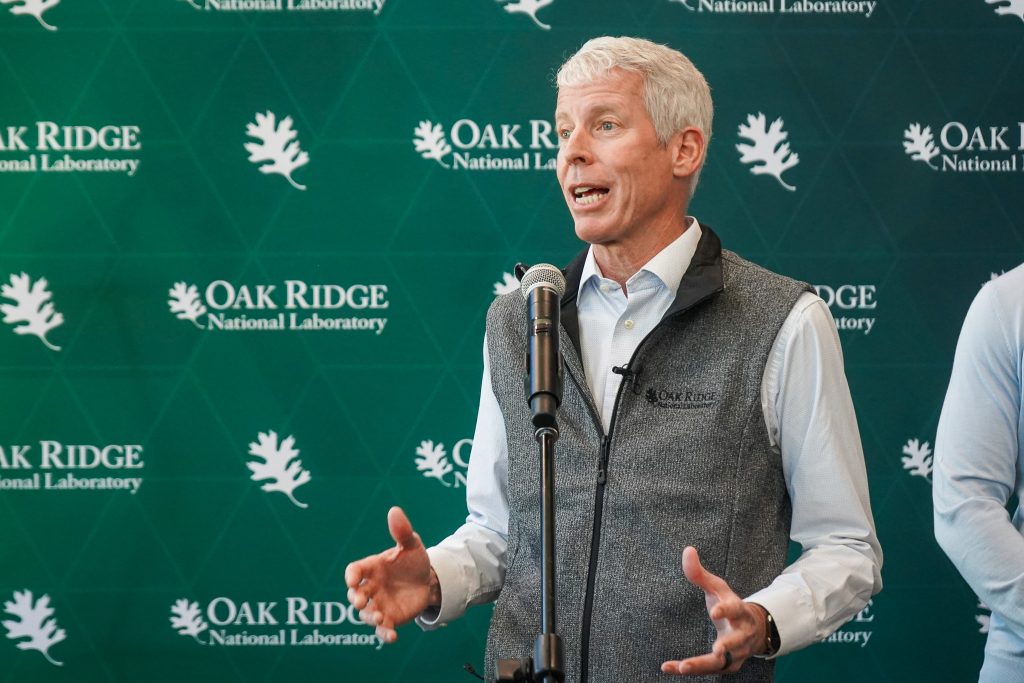
The intention behind the two new computer systems is to enable researchers to explore innovative AI-centric approaches, supporting a new wave of innovations in energy, manufacturing, medicine, and cybersecurity.
“National Labs are perfectly suited to support this unique public private partnership because of our ability to assemble and steward curated data for national priorities that have an inherently federal interest; because of our deep technical expertise in the development and application of AI for science and technology at scale; and because of our demonstrated ability to deploy hardware and software at scale for these missions,” said ORNL Director Stephen Streiffer.
Insights made possible by the Discovery supercomputer will help realize the full potential of many innovations, including:
- AI modeling to make nuclear energy safer, cheaper, and more available
- AI-driven digital twins for precision medicine and patient health
- Aerospace design cycles shortened from years to months for faster, more fuel-efficient aircraft
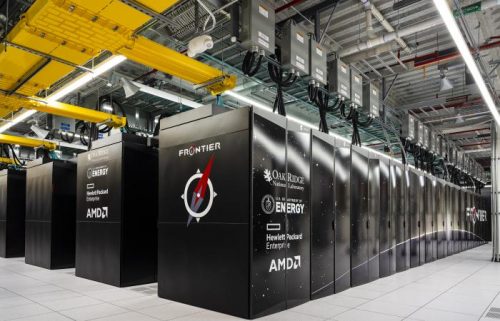
Discovery will be delivered in 2028 with significantly greater performance than Frontier, ORNL’s current flagship supercomputer.
The Lux AI Cluster, to be deployed at ORNL in early 2026, will expand DOE’s near-term AI capacity and accelerate progress on critical problems, including fusion, fission, materials, quantum, advanced manufacturing, and the grid.
DOE officials said its investment in Lux reflects HPE and AMD’s trusted and proven leadership in advanced computing, including the delivery of Frontier, the first supercomputer to break the exascale barrier.
ORNL is also home to the Oak Ridge Leadership Computing Facility, a DOE Office of Science user facility, which has deployed a total of seven flagship supercomputers since 2004. Each of the last four machines – Jaguar, Titan, Summit, and Frontier – was recognized as the world’s fastest system of its time.
“The Discovery and Lux systems will drive scientific innovation faster and farther than ever before,” said Streiffer. “ORNL’s leadership in supercomputing has dramatically shortened researchers’ time from problem to solution across a host of fields and industries. With Discovery and Lux, the integration of high-performance computing and AI promises breakthroughs at the accelerated speed and scale necessary for continued U.S. leadership in an increasingly competitive global environment.”
Like what you've read?
Forward to a friend!