

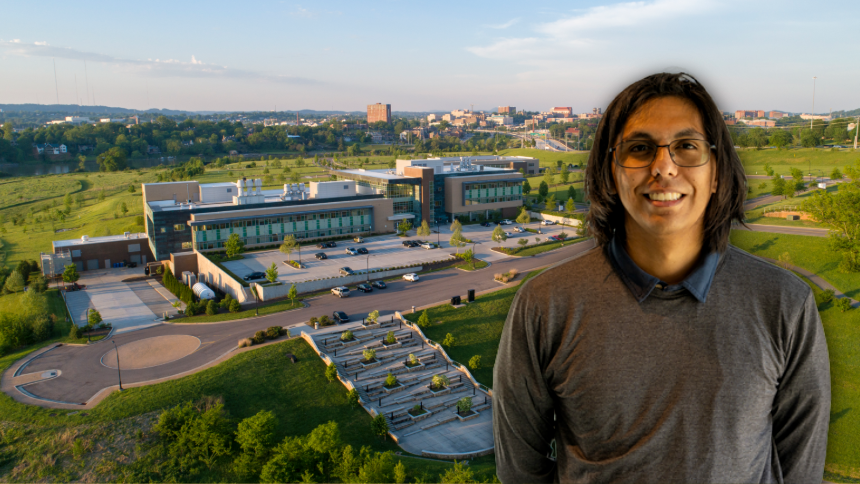
Erasmus Energy is reimagining radioisotope production through the Spark accelerator
Hear from co-founder Marcos Perez on the company's background, its mission and why scaling in East Tennessee is strategic.
Founded by Marcos Perez and Carlos Ayala, Erasmus Energy is developing faster, more affordable ways to produce radioisotopes for energy and medical uses.
The company is based in Los Angeles, California but is currently getting a taste for Tennessee by participating in the 2026 Spark cohort.
Q: How did this company come to be?
I grew up in California and did my undergrad at Caltech where I met my co-founder. After taking some grad-level physics classes, I fell into this rabbit hole around radioisotopes. How scarce and important they are, and how we could produce them better. For the past several years, we’ve been running computer simulations on every known process ever used to produce radioisotopes, combined with experimental data that’s been publicly shared in large databases going back to the late 1920s. We simulated the production of all 2,400 known radioisotopes, generating tens of thousands of simulations across the different production methods for each. Not all of those are useful, of course — so we’ve narrowed it down to the 10 or so best methods per isotope, depending on the application.
Q: What are some of those applications?
The quickest way to really hit the ground running is using them for cancer treatment and diagnosis. Radioisotopes are pretty important for certain types of cancer therapy or isotope markers for where tumors might be in the body. But another application is using them for energy production. For example, for the past 50 years, NASA has been using isotope-powered batteries to power their deep space missions.
Q: What stage is the company in?
We were founded in 2024. With our research background, we got so into the simulations. But two years ago, we realized it was more than just a hobby. We know that if we wanted to move as fast as possible and make change, we had to be within the private sector. We’ve gone as far as anyone can with just simulations. Now, we have to build it. We’re starting a pre-seed round and pursuing physical prototypes.
Q: Why here, why now?
Making isotope isn’t the newest idea. People have been at this for a while, and historically, facilities like Oak Ridge National Laboratory and the University of Tennessee have produced close to the lion’s share of radioisotopes used by organizations like NASA. When I did some reading and found out that programs like Spark exist, it was great. Being able to meet and work with these industry connections here in Knoxville is pretty awesome. Our work-in-progress tagline is ‘producer of cheap rapidly-producible radioisotopes for energy and medicine.’ The key is that these radioisotopes have to be more accessible for true impact and innovation, and that needs to happen now to help the world.
Q: Where does the name come from?
I get really into etymology. I read about something called corona discharge, which is this really cool sparking effect between an energy source and metal. Historically, it’s happened on ships’ masts and it’s called Saint Elmo’s fire. According to sailors, it’s a good omen and alludes to Saint Elmos which is short-hand for the Eramsus of Formia. He’s the patron saint of sailors. One of the largest applications that you could use radioisotopes for is electric cargo ships, which is a very long-term goal of ours.
Stay tuned to see their progress throughout the cohort!
Like what you've read?
Forward to a friend!